隋 (suí) means "Sui (Dynasty)" in Chinese. It has 11 strokes with the radical 阝.
Rated 3.9/5 in difficulty (challenging).
Appears in 3+ common words including 隋朝 (suí cháo), 隋代 (suí dài), 隋文帝 (suí wén dì).
Due to its 11 strokes, Hanzi Writer's error detection shows 隋 requires focused practice — most learners need 10+ attempts for consistent accuracy.
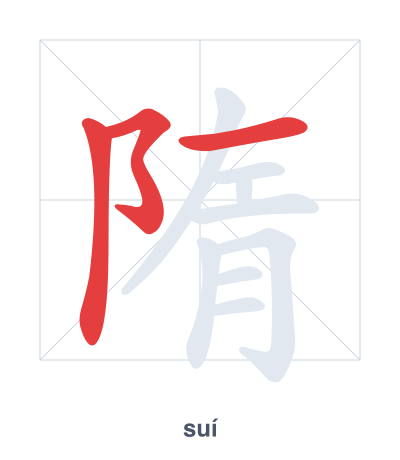
Open Hanzi Writer to see the animated stroke order and practice writing 隋 with real-time feedback.
The character 隋 (suí) is written with 11 strokes. Follow the standard Chinese stroke order: top to bottom, left to right, outside before inside. The radical 阝 is one of its key components.
Practice the correct stroke order with the Hanzi Writer app to see animated stroke-by-stroke guidance with real-time feedback.
隋 means Sui (Dynasty).
左 (left hand) plus 月 (moon/body) combine with the radical 阝 (hill/mound) to form 隋. Originally a place name, it was adopted for the Sui Dynasty. The visual suggests a hill (阝) with a left hand (左) grasping a moon (月), hinting at the dynasty's unity of celestial and earthly power.
💡 Memory Tip: Imagine a left hand (左) holding a crescent moon (月) on top of a hill (阝), representing the brief but brilliant Sui Dynasty.
隋朝的历史非常短。
suí cháo de lì shǐ fēi cháng duǎn
The history of the Sui Dynasty was very short.
这是隋代的艺术品。
zhè shì suí dài de yì shù pǐn
This is an artwork from the Sui Dynasty.
隋文帝统一了中国。
suí wén dì tǒng yī liǎo zhōng guó
Emperor Wen of Sui unified China.
Open Hanzi Writer to see the animated stroke order and practice writing 隋 with real-time feedback.
✨ Animated stroke order · Handwriting recognition · HSK-graded practice · Free to use
The character 隋 is made of the left radical 阝 (representing a hill or mound) and a right part that combines a short stroke, 工 (work), and 月 (moon). The right part acts as a phonetic hint for the pronunciation suí, while the left radical is a common component in place names and dynasties. Together, they form a character that primarily refers to the historical Sui Dynasty, not to literal hills or work.