薮 (sǒu) means "Marsh / Thicket" in Chinese. It has 16 strokes with the radical 艹.
Rated 4.2/5 in difficulty (advanced).
Appears in 3+ common words including 渊薮 (yuān sǒu), 薮泽 (sǒu zé), 蜂薮 (fēng sǒu).
Due to its 16 strokes, Hanzi Writer's error detection shows 薮 requires focused practice — most learners need 10+ attempts for consistent accuracy.
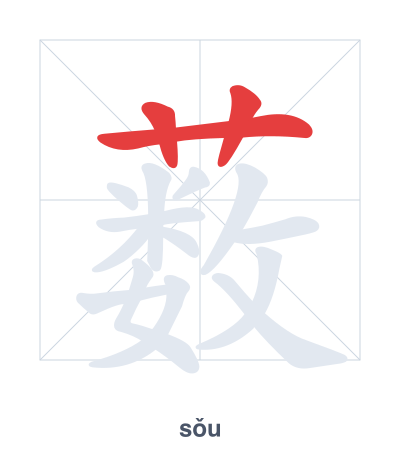
Open Hanzi Writer to see the animated stroke order and practice writing 薮 with real-time feedback.
The character 薮 (sǒu) is written with 16 strokes. Follow the standard Chinese stroke order: top to bottom, left to right, outside before inside. The radical 艹 is one of its key components.
Practice the correct stroke order with the Hanzi Writer app to see animated stroke-by-stroke guidance with real-time feedback.
薮 means Marsh / Thicket.
薮 is a compound character with the radical 艹 (grass) and the phonetic component 數 (shù, meaning 'count' or 'many'). The grass radical indicates a place of vegetation, while 數 suggests abundant growth, forming the meaning of a marshy thicket overgrown with plants.
💡 Memory Tip: Picture a swamp where you count (数) the countless reeds (艹) sprouting from the water to form a dense thicket.
这里是人才的渊薮。
zhè lǐ shì rén cái de yuān sǒu
This is a gathering place for talent.
薮泽里有很多小鱼。
sǒu zé lǐ yǒu hěn duō xiǎo yú
There are many small fish in the marsh.
游客如蜂薮般聚集。
yóu kè rú fēng sǒu bān jù jí
Tourists gathered like a swarm of bees.
Open Hanzi Writer to see the animated stroke order and practice writing 薮 with real-time feedback.
✨ Animated stroke order · Handwriting recognition · HSK-graded practice · Free to use
The character 薮 is made of the grass radical 艹 on top and the phonetic component 数 (shù) below. The grass radical indicates that the character relates to plants or vegetation, while the whole character refers to a marshy area or thicket overgrown with grass and bushes.