擞 (sǒu) means "to shake; to rouse" in Chinese. It has 16 strokes with the radical 扌.
Rated 4.2/5 in difficulty (advanced).
Appears in 3+ common words including 精神抖擞 (jīng shén dǒu sǒu), 抖擞 (dǒu sǒu), 擞动 (sǒu dòng).
Due to its 16 strokes, Hanzi Writer's error detection shows 擞 requires focused practice — most learners need 10+ attempts for consistent accuracy.
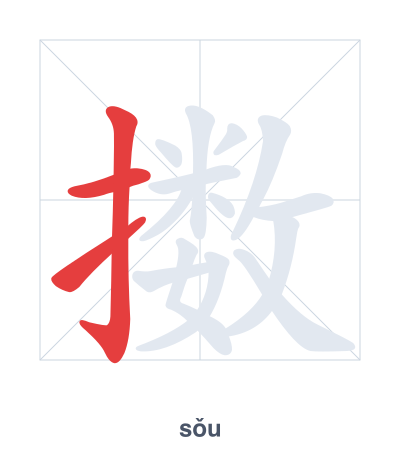
Open Hanzi Writer to see the animated stroke order and practice writing 擞 with real-time feedback.
The character 擞 (sǒu) is written with 16 strokes. Follow the standard Chinese stroke order: top to bottom, left to right, outside before inside. The radical 扌 is one of its key components.
Practice the correct stroke order with the Hanzi Writer app to see animated stroke-by-stroke guidance with real-time feedback.
擞 means to shake; to rouse.
The character 擞 combines the hand radical 扌, indicating an action performed by the hand, with the phonetic component 数 (meaning 'number' or 'to count'). The original meaning relates to shaking or rousing something, as if using one's hand to jolt or stir up a number of items.
💡 Memory Tip: Imagine a hand (扌) frantically shaking a stack of numbered papers (数) to rouse them into order.
他今天精神抖擞。
tā jīn tiān jīng shén dǒu sǒu
He is full of energy today.
鸟儿抖擞着羽毛。
niǎo ér dǒu sǒu zhe yǔ máo
The bird is shaking its feathers.
他擞动了一下身体。
tā sǒu dòng le yī xià shēn tǐ
He shook his body.
Open Hanzi Writer to see the animated stroke order and practice writing 擞 with real-time feedback.
✨ Animated stroke order · Handwriting recognition · HSK-graded practice · Free to use
擞 is composed of the hand radical 扌 on the left and the phonetic component 数 on the right. The hand radical indicates that the action involves the hand, so 'to shake' or 'to rouse' is a hand movement. The right side 数 gives the approximate pronunciation sǒu, though it does not directly contribute to the meaning.