厮 (sī) means "servant; each other" in Chinese. It has 14 strokes with the radical 厂.
Rated 3.9/5 in difficulty (challenging).
Appears in 3+ common words including 厮打 (sī dǎ), 厮守 (sī shǒu), 厮混 (sī hùn).
Due to its 14 strokes, Hanzi Writer's error detection shows 厮 requires focused practice — most learners need 10+ attempts for consistent accuracy.
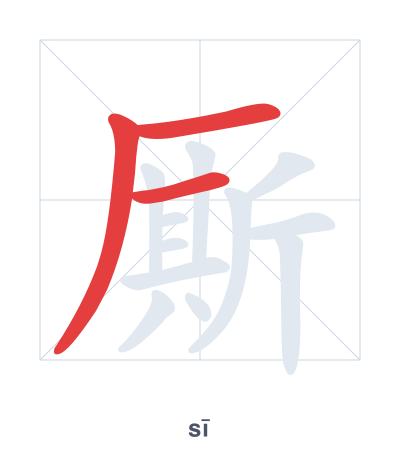
Open Hanzi Writer to see the animated stroke order and practice writing 厮 with real-time feedback.
The character 厮 (sī) is written with 14 strokes. Follow the standard Chinese stroke order: top to bottom, left to right, outside before inside. The radical 厂 is one of its key components.
Practice the correct stroke order with the Hanzi Writer app to see animated stroke-by-stroke guidance with real-time feedback.
厮 means servant; each other.
| Character | 厮 |
| Pinyin | sī (si) |
| Meaning | servant; each other |
| Strokes | 14 |
| Radical | 厂 |
| Difficulty | 3.9/5 |
The character 厮 is a compound with the radical 厂 (cliff or shelter) and the phonetic component 斯 (sī). Originally, it referred to a servant working in a humble shelter under a cliff. Later, it extended to mean 'each other' in contexts like fighting or interacting mutually.
💡 Memory Tip: Picture a servant (厮) under a cliff (厂) using an axe (斤) to chop a sheaf of wheat (其) while another servant does the same—they are 'each other's' partners in labor.
两个人在路边厮打。
liǎng gè rén zài lù biān sī dǎ
Two people are fighting on the roadside.
他们决定终生厮守。
tā men jué dìng zhōng shēng sī shǒu
They decided to stay together for the rest of their lives.
他整天在外面厮混。
tā zhěng tiān zài wài miàn sī hùn
He hangs out outside all day long.
Open Hanzi Writer to see the animated stroke order and practice writing 厮 with real-time feedback.
✨ Animated stroke order · Handwriting recognition · HSK-graded practice · Free to use
厮 combines the radical 厂 (cliff) on the left with the character 斯 (sī) on the right. The radical 厂 gives a sense of a place, while 斯 originally meant 'to split' or 'this,' but together they suggest a person serving in a humble setting. The structure points to a servant who stays in a confined area, like a household.