丝 (sī) means "Silk / Thread" in Chinese. It has 5 strokes with the radical 一, and is HSK Level 7.
Rated 2.7/5 in difficulty (moderate).
Harder than 3% of HSK Level 7 characters.
Appears in 3+ common words including 丝绸 (sī chóu), 粉丝 (fěn sī), 丝毫 (sī háo).
Hanzi Writer's stroke validation shows learners typically need 5-8 attempts to write 丝 with correct proportion and order.
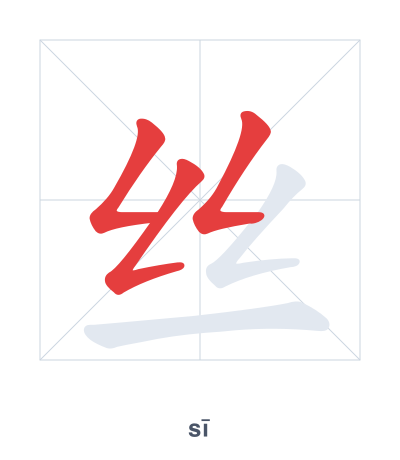
Open Hanzi Writer to see the animated stroke order and practice writing 丝 with real-time feedback.
The character 丝 (sī) is written with 5 strokes. Follow the standard Chinese stroke order: top to bottom, left to right, outside before inside. The radical 一 is one of its key components.
Practice the correct stroke order with the Hanzi Writer app to see animated stroke-by-stroke guidance with real-time feedback.
丝 means Silk / Thread.
As an HSK Level 7 character, 丝 is an intermediate-level character.
丝 (sī) originally depicted two twisted bundles of silk threads, showing the character's meaning of silk or thread. The ancient form was a pictograph of two strands, which over time simplified into the modern shape with two 纟 (silk radical) components stacked side by side, though in the simplified form they appear as 纟 and a simplified second element.
💡 Memory Tip: Imagine two silkworms (the two 纟 components) spinning a shiny thread together to form the character 丝 for silk.
中国的丝绸很有名。
zhōng guó de sī chóu hěn yǒu míng
Chinese silk is very famous.
他有很多微博粉丝。
tā yǒu hěn duō wēi bó fěn sī
He has many Weibo followers.
他丝毫没有害怕。
tā sī háo méi yǒu hài pà
He wasn't afraid at all.
Open Hanzi Writer to see the animated stroke order and practice writing 丝 with real-time feedback.
✨ Animated stroke order · Handwriting recognition · HSK-graded practice · Free to use
丝 is composed of two small '糸' (silk thread) components stacked vertically, representing twisted silk fibers. The radical 一 is a horizontal line that can be seen as a frame or base, but the core meaning comes from the two thread-like elements, directly symbolizing silk or thread.