甩 (shuǎi) means "To throw; to fling; to swing." in Chinese. It has 5 strokes with the radical 用, and is HSK Level 7.
Rated 2.7/5 in difficulty (moderate).
Harder than 4% of HSK Level 7 characters.
Appears in 3+ common words including 甩掉 (shuǎi diào), 甩手 (shuǎi shǒu), 甩卖 (shuǎi mài).
Hanzi Writer's stroke validation shows learners typically need 5-8 attempts to write 甩 with correct proportion and order.
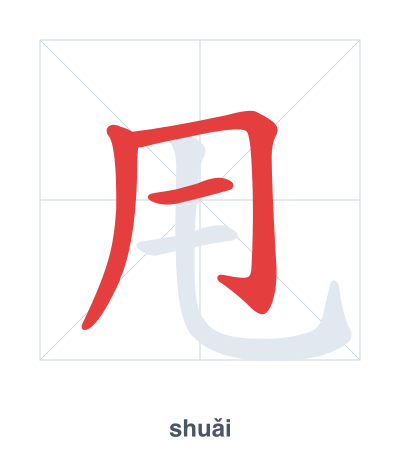
Open Hanzi Writer to see the animated stroke order and practice writing 甩 with real-time feedback.
The character 甩 (shuǎi) is written with 5 strokes. Follow the standard Chinese stroke order: top to bottom, left to right, outside before inside. The radical 用 is one of its key components.
Practice the correct stroke order with the Hanzi Writer app to see animated stroke-by-stroke guidance with real-time feedback.
甩 means To throw; to fling; to swing..
As an HSK Level 7 character, 甩 is an intermediate-level character.
甩 is a compound character combining 用 (to use) with a curved stroke that suggests a swinging or flinging motion, as if using a tool to throw something away. The bottom hook visually represents the action of flicking or tossing an object.
💡 Memory Tip: Imagine using (用) a slingshot and flicking the hook-shaped handle to fling a rock away.
他想甩掉烦恼。
tā xiǎng shuǎi diào fán nǎo
He wants to shake off his worries.
他甩手走开了。
tā shuǎi shǒu zǒu kāi le
He swung his arms and walked away.
商店正在大甩卖。
shāng diàn zhèng zài dà shuǎi mài
The store is having a big clearance sale.
Open Hanzi Writer to see the animated stroke order and practice writing 甩 with real-time feedback.
✨ Animated stroke order · Handwriting recognition · HSK-graded practice · Free to use
The character 甩 consists of the radical 用 (meaning "use") with a curved stroke on top that looks like something being thrown away. This top stroke represents the action of flinging or swinging, while 用 suggests the object being used in the motion. Together, the structure visually depicts using your hand to toss something aside.