甪 (lù) means "Lu (a character used in place names)." in Chinese. It has 6 strokes with the radical 用.
Rated 3.2/5 in difficulty (challenging).
Appears in 3+ common words including 甪直 (lù zhí), 甪里 (lù lǐ), 甪端 (lù duān).
Due to its 6 strokes, Hanzi Writer's error detection shows 甪 requires focused practice — most learners need 10+ attempts for consistent accuracy.
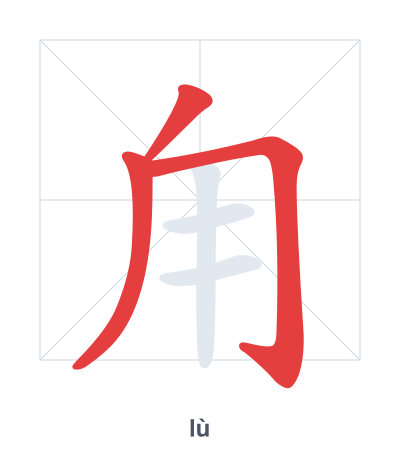
Open Hanzi Writer to see the animated stroke order and practice writing 甪 with real-time feedback.
The character 甪 (lù) is written with 6 strokes. Follow the standard Chinese stroke order: top to bottom, left to right, outside before inside. The radical 用 is one of its key components.
Practice the correct stroke order with the Hanzi Writer app to see animated stroke-by-stroke guidance with real-time feedback.
甪 means Lu (a character used in place names)..
| Character | 甪 |
| Pinyin | lù (lu) |
| Meaning | Lu (a character used in place names). |
| Strokes | 6 |
| Radical | 用 |
| Difficulty | 3.2/5 |
甪 is a compound character combining 用 (use) with a diagonal stroke (丿) on top, possibly indicating a variant of 角 (horn) simplified for use in place names. Its form in ancient scripts is unclear, as it is a rare character primarily used in toponyms like 甪直 (Luzhi). The radical 用 suggests functionality, while the added stroke may serve as a distinguishing mark.
💡 Memory Tip: Picture a person (丿) using (用) a horn-shaped tool to carve a road sign for the place called Lu.
甪直是一个古镇。
lù zhí shì yí gè gǔ zhèn
Luzhi is an ancient town.
甪里在江苏省。
lù lǐ zài jiāng sū shěng
Luli is in Jiangsu Province.
甪端是古代神兽。
lù duān shì gǔ dài shén shòu
Luduan is an ancient mythical beast.
Open Hanzi Writer to see the animated stroke order and practice writing 甪 with real-time feedback.
✨ Animated stroke order · Handwriting recognition · HSK-graded practice · Free to use
The character 甪 combines the radical 用 (yòng, "use") on the right with a left component that resembles 人 (rén, "person") but is actually a variant of 角 (jiǎo, "horn"). This structure appears in ancient place names and mythical creatures, so the character's form hints at its use in proper names rather than a literal meaning.