绶 (shòu) means "ribbon (for a seal or medal)" in Chinese. It has 11 strokes with the radical 纟.
Rated 4.2/5 in difficulty (advanced).
Appears in 3+ common words including 绶带 (shòu dài), 勋绶 (xūn shòu), 印绶 (yìn shòu).
Due to its 11 strokes, Hanzi Writer's error detection shows 绶 requires focused practice — most learners need 10+ attempts for consistent accuracy.
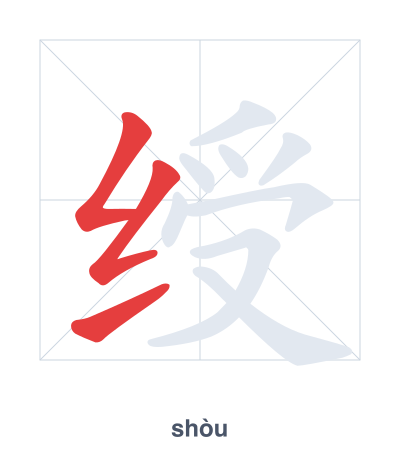
Open Hanzi Writer to see the animated stroke order and practice writing 绶 with real-time feedback.
The character 绶 (shòu) is written with 11 strokes. Follow the standard Chinese stroke order: top to bottom, left to right, outside before inside. The radical 纟 is one of its key components.
Practice the correct stroke order with the Hanzi Writer app to see animated stroke-by-stroke guidance with real-time feedback.
绶 means ribbon (for a seal or medal).
绶 combines the silk radical 纟 (silk thread) with 受 (shòu, 'to receive'), indicating a silk ribbon used to receive and attach official seals or medals. The right side 受 itself shows a hand (爪) reaching down to hold something under a cover (冖), with another hand (又) below, symbolizing the act of receiving—fitting for a ribbon that secures an insignia of rank.
💡 Memory Tip: Picture two hands (the top and bottom of 受) passing a shining medal tied with a silk ribbon (纟) to a new official.
礼服上挂着绶带。
lǐ fú shàng guà zhe shòu dài
A ribbon is hanging on the formal attire.
他获得了一枚勋绶。
tā huò dé le yī méi xūn shòu
He received a medal and ribbon.
古代官员佩戴印绶。
gǔ dài guān yuán pèi dài yìn shòu
Ancient officials wore seals and ribbons.
Open Hanzi Writer to see the animated stroke order and practice writing 绶 with real-time feedback.
✨ Animated stroke order · Handwriting recognition · HSK-graded practice · Free to use
The left side is 纟 (silk radical), which connects to the idea of a ribbon made of silk. The right side is 受 (shòu, meaning 'to receive'), hinting that the ribbon is used to receive or attach a seal or medal. Together, 绶 means a ribbon worn as a symbol of office or honor.