绅 (shēn) means "gentry, sash" in Chinese. It has 8 strokes with the radical 纟, and is HSK Level 7.
Rated 3.7/5 in difficulty (challenging).
Harder than 29% of HSK Level 7 characters.
Appears in 3+ common words including 绅士 (shēn shì), 乡绅 (xiāng shēn), 官绅 (guān shēn).
Due to its 8 strokes, Hanzi Writer's error detection shows 绅 requires focused practice — most learners need 10+ attempts for consistent accuracy.
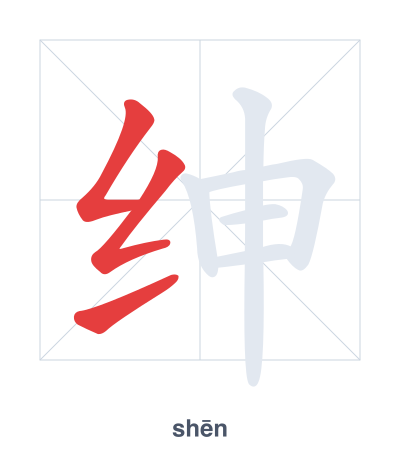
Open Hanzi Writer to see the animated stroke order and practice writing 绅 with real-time feedback.
The character 绅 (shēn) is written with 8 strokes. Follow the standard Chinese stroke order: top to bottom, left to right, outside before inside. The radical 纟 is one of its key components.
Practice the correct stroke order with the Hanzi Writer app to see animated stroke-by-stroke guidance with real-time feedback.
绅 means gentry, sash.
As an HSK Level 7 character, 绅 is an intermediate-level character.
绅 combines the silk radical 纟 (silk thread) with 申 (shēn, meaning 'extend' or 'state'), which also provides the sound. The original meaning was a sash or belt made of silk, worn by officials and scholars, hence extending to 'gentry' as a social class. The character visually depicts a silk cord (纟) that is 'extended' or drawn through a waistband (申's ancient form shows a coiled serpent, but here it acts phonetically).
💡 Memory Tip: A gentleman with a silk sash (纟) extends his hand (申) to welcome you into the gentry.
他是一个很有礼貌的绅士。
tā shì yí gè hěn yǒu lǐ mào de shēn shì
He is a very polite gentleman.
以前这里住着很多乡绅。
yǐ qián zhè lǐ zhù zhe hěn duō xiāng shēn
Many local gentry used to live here.
这里的官绅都很出名。
zhè lǐ de guān shēn dōu hěn chū míng
The local gentry here are all very famous.
Open Hanzi Writer to see the animated stroke order and practice writing 绅 with real-time feedback.
✨ Animated stroke order · Handwriting recognition · HSK-graded practice · Free to use
绅 is made of the radical 纟 (silk) on the left and the phonetic component 申 (shēn) on the right. The silk radical relates to clothing or sashes, and 申 provides the sound. Together, they originally referred to a sash or belt, which later extended to mean a member of the gentry who wore such sashes.