猞 (shē) means "lynx (used in 猞猁)" in Chinese. It has 11 strokes with the radical 犭.
Rated 4.2/5 in difficulty (advanced).
Appears in 3+ common words including 猞猁 (shē lì), 猞猁狲 (shē lì sūn), 猞猁皮 (shē lì pí).
Due to its 11 strokes, Hanzi Writer's error detection shows 猞 requires focused practice — most learners need 10+ attempts for consistent accuracy.
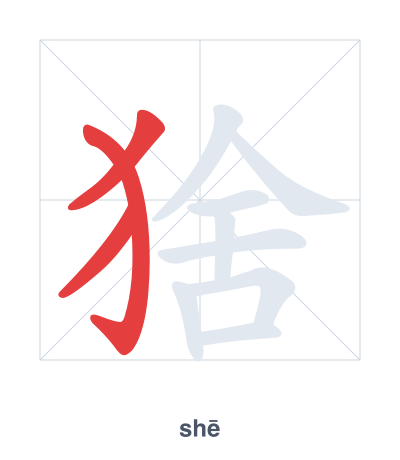
Open Hanzi Writer to see the animated stroke order and practice writing 猞 with real-time feedback.
The character 猞 (shē) is written with 11 strokes. Follow the standard Chinese stroke order: top to bottom, left to right, outside before inside. The radical 犭 is one of its key components.
Practice the correct stroke order with the Hanzi Writer app to see animated stroke-by-stroke guidance with real-time feedback.
猞 means lynx (used in 猞猁).
猞 is a compound character with the radical 犭 (animal) and 舍 (shě, meaning house or shed) serving as a phonetic component to suggest the pronunciation. It is used in the word 猞猁 (shēlì), which refers to the lynx, a wild cat known for its tufted ears and stealthy hunting.
💡 Memory Tip: Picture a lynx (犭) peeking out from a shed (舍) — that's the 猞 in 猞猁.
猞猁在雪地里奔跑。
shē lì zài xuě dì lǐ bēn pǎo
The lynx is running in the snow.
猞猁狲的耳朵很尖。
shē lì sūn de ěr duǒ hěn jiān
The lynx's ears are very pointed.
这件大衣是猞猁皮的。
zhè jiàn dà yī shì shē lì pí de
This coat is made of lynx fur.
Open Hanzi Writer to see the animated stroke order and practice writing 猞 with real-time feedback.
✨ Animated stroke order · Handwriting recognition · HSK-graded practice · Free to use
The left side is the radical 犭, which means "animal" or "dog." The right side is 舍 (shē, meaning house or hut), and it gives the character its pronunciation. Together, 猞 refers to the lynx, a wild cat that is an animal.