狲 (sūn) means "monkey" in Chinese. It has 9 strokes with the radical 犭.
Rated 4/5 in difficulty (challenging).
Appears in 3+ common words including 猢狲 (hú sūn), 狲猴 (sūn hóu), 猢狲散 (hú sūn sàn).
Due to its 9 strokes, Hanzi Writer's error detection shows 狲 requires focused practice — most learners need 10+ attempts for consistent accuracy.
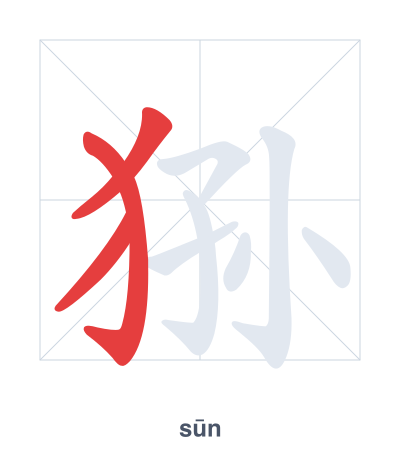
Open Hanzi Writer to see the animated stroke order and practice writing 狲 with real-time feedback.
The character 狲 (sūn) is written with 9 strokes. Follow the standard Chinese stroke order: top to bottom, left to right, outside before inside. The radical 犭 is one of its key components.
Practice the correct stroke order with the Hanzi Writer app to see animated stroke-by-stroke guidance with real-time feedback.
狲 means monkey.
This character combines the animal radical 犭 with the phonetic component 孙 (sūn, meaning 'grandson') to indicate a type of monkey. The radical shows it's an animal, while 孙 provides the pronunciation.
💡 Memory Tip: Picture a mischievous monkey (犭) wearing a tiny grandson's (孙) outfit, chattering and swinging from branches.
树上有一群猢狲。
shù shàng yǒu yī qún hú sūn
There is a troop of monkeys in the tree.
狲猴非常聪明。
sūn hóu fēi cháng cōng míng
Monkeys are very clever.
大家都猢狲散了。
dà jiā dōu hú sūn sàn le
Everyone scattered in all directions.
Open Hanzi Writer to see the animated stroke order and practice writing 狲 with real-time feedback.
✨ Animated stroke order · Handwriting recognition · HSK-graded practice · Free to use
狲 is a phono-semantic compound. The left radical 犭 (dog radical) indicates it is an animal, and the right part 孙 (sūn) provides the pronunciation. Together, it means "monkey."