猁 (lì) means "lynx" in Chinese. It has 10 strokes with the radical 犭.
Rated 4.2/5 in difficulty (advanced).
Appears in 3+ common words including 猞猁 (shē lì), 小猞猁 (xiǎo shē lì), 猞猁皮 (shē lì pí).
Due to its 10 strokes, Hanzi Writer's error detection shows 猁 requires focused practice — most learners need 10+ attempts for consistent accuracy.
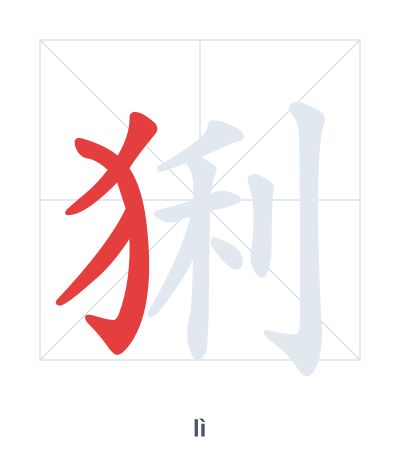
Open Hanzi Writer to see the animated stroke order and practice writing 猁 with real-time feedback.
The character 猁 (lì) is written with 10 strokes. Follow the standard Chinese stroke order: top to bottom, left to right, outside before inside. The radical 犭 is one of its key components.
Practice the correct stroke order with the Hanzi Writer app to see animated stroke-by-stroke guidance with real-time feedback.
猁 means lynx.
This character is a phono-semantic compound. The radical 犭 (a simplified form of 犬, 'dog') signals it is a wild animal, while 利 (lì, 'sharp') provides the pronunciation and hints at the lynx's sharp claws and keen hunting ability.
💡 Memory Tip: Imagine a lynx with a sharp (利) animal (犭) claw that can slice through anything.
猞猁长得有点像猫。
shē lì zhǎng dé yǒu diǎn xiàng māo
A lynx looks a bit like a cat.
这只小猞猁很可爱。
zhè zhǐ xiǎo shē lì hěn kě ài
This little lynx is very cute.
猞猁皮非常暖和。
shē lì pí fēi cháng nuǎn huo
Lynx fur is very warm.
Open Hanzi Writer to see the animated stroke order and practice writing 猁 with real-time feedback.
✨ Animated stroke order · Handwriting recognition · HSK-graded practice · Free to use
猁 is composed of the radical 犭 (dog/animal) on the left and the phonetic component 利 (lì, meaning sharp/benefit) on the right. The radical indicates this character relates to an animal, while the sound of 利 gives the pronunciation lì. Together, they form the word for "lynx," a wild cat known for its sharp hunting skills.