垧 (shǎng) means "shang (unit of land area)" in Chinese. It has 9 strokes with the radical 土.
Rated 4/5 in difficulty (challenging).
Appears in 3+ common words including 一垧地 (yī shǎng dì), 几垧 (jǐ shǎng), 垧地 (shǎng dì).
Due to its 9 strokes, Hanzi Writer's error detection shows 垧 requires focused practice — most learners need 10+ attempts for consistent accuracy.
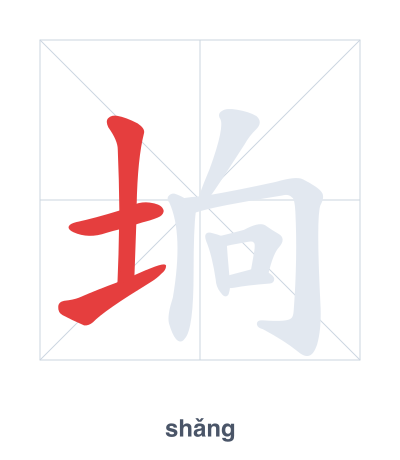
Open Hanzi Writer to see the animated stroke order and practice writing 垧 with real-time feedback.
The character 垧 (shǎng) is written with 9 strokes. Follow the standard Chinese stroke order: top to bottom, left to right, outside before inside. The radical 土 is one of its key components.
Practice the correct stroke order with the Hanzi Writer app to see animated stroke-by-stroke guidance with real-time feedback.
垧 means shang (unit of land area).
垧 is a phono-semantic compound with the radical 土 (earth/land) and the phonetic component 向 (xiàng, meaning 'direction' or 'toward'). It denotes a traditional Chinese unit of land area, visually connecting land (土) with a sense of orientation or extent.
💡 Memory Tip: Picture a farmer looking toward (向) a patch of land (土) to estimate how many 垧 it covers.
我家有一垧地。
wǒ jiā yǒu yī shǎng dì
My family has one shang of land.
你种了几垧大豆?
nǐ zhǒng le jǐ shǎng dà dòu
How many hectares of soybeans did you plant?
这片垧地很肥沃。
zhè piàn shǎng dì hěn féi wò
This plot of land is very fertile.
Open Hanzi Writer to see the animated stroke order and practice writing 垧 with real-time feedback.
✨ Animated stroke order · Handwriting recognition · HSK-graded practice · Free to use
垧 is a left-right structure. The left component 土 means 'earth' or 'land', which connects to the character's meaning as a land area unit. The right component 向 provides a phonetic hint, though its pronunciation (xiàng) is not exactly the same as shǎng.