骟 (shàn) means "To castrate (an animal)" in Chinese. It has 13 strokes with the radical 马.
Rated 4.2/5 in difficulty (advanced).
Appears in 3+ common words including 骟马 (shàn mǎ), 骟猪 (shàn zhū), 骟割 (shàn gē).
Due to its 13 strokes, Hanzi Writer's error detection shows 骟 requires focused practice — most learners need 10+ attempts for consistent accuracy.
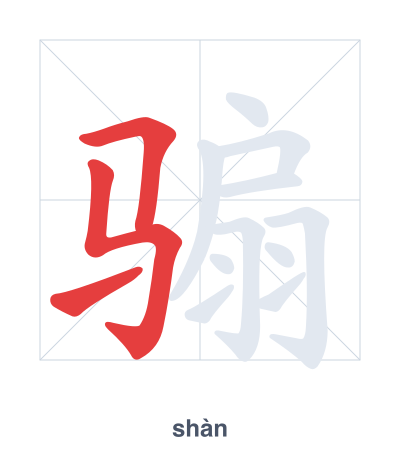
Open Hanzi Writer to see the animated stroke order and practice writing 骟 with real-time feedback.
The character 骟 (shàn) is written with 13 strokes. Follow the standard Chinese stroke order: top to bottom, left to right, outside before inside. The radical 马 is one of its key components.
Practice the correct stroke order with the Hanzi Writer app to see animated stroke-by-stroke guidance with real-time feedback.
骟 means To castrate (an animal).
骟 combines the radical 马 (horse) with the phonetic component 扇 (shàn, meaning 'fan'). The character specifically refers to the castration of horses, with 扇 providing the sound and the horse radical indicating the animal involved.
💡 Memory Tip: Picture a horse (马) nervously fanning itself with a large fan (扇) after being castrated, trying to cool down from the shock.
农夫在喂那匹骟马。
nóng fū zài wèi nà pǐ shàn mǎ
The farmer is feeding that gelding.
他学会了如何骟猪。
tā xué huì le rú hé shàn zhū
He learned how to castrate pigs.
这种技术叫作骟割。
zhè zhǒng jì shù jiào zuò shàn gē
This technique is called gelding (animal castration).
Open Hanzi Writer to see the animated stroke order and practice writing 骟 with real-time feedback.
✨ Animated stroke order · Handwriting recognition · HSK-graded practice · Free to use
骟 is a left-right structure. The left part 马 means 'horse', indicating the character relates to horses. The right part 扇 (shàn, a fan) provides the sound clue, as 骟 is pronounced shàn. Together, the character refers to castrating a horse or other animals.