骒 (kè) means "Mare (female horse)" in Chinese. It has 11 strokes with the radical 马.
Rated 4.2/5 in difficulty (advanced).
Appears in 3+ common words including 骒马 (kè mǎ), 骒骡 (kè luó), 母骒 (mǔ kè).
Due to its 11 strokes, Hanzi Writer's error detection shows 骒 requires focused practice — most learners need 10+ attempts for consistent accuracy.
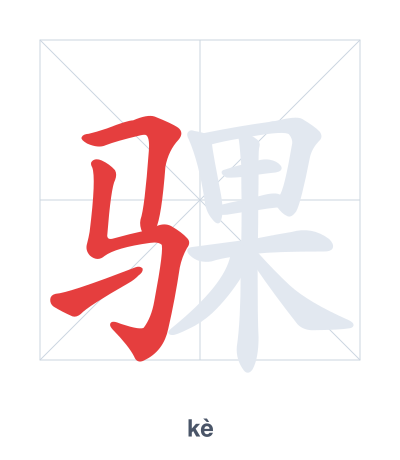
Open Hanzi Writer to see the animated stroke order and practice writing 骒 with real-time feedback.
The character 骒 (kè) is written with 11 strokes. Follow the standard Chinese stroke order: top to bottom, left to right, outside before inside. The radical 马 is one of its key components.
Practice the correct stroke order with the Hanzi Writer app to see animated stroke-by-stroke guidance with real-time feedback.
骒 means Mare (female horse).
骒 is a compound character with the radical 马 (horse) indicating the meaning, and the component 果 (fruit, pronounced guǒ) providing the phonetic clue for the pronunciation kè. A mare is a female horse, and the horse radical directly connects to the meaning, while 果 is purely phonetic.
💡 Memory Tip: Picture a mare (马) munching on a giant fruit (果) to remember that 骒 means 'mare'.
那匹骒马正在吃草。
nà pǐ kè mǎ zhèng zài chī cǎo
That mare is grazing.
农场里有一头骒骡。
nóng chǎng lǐ yǒu yī tóu kè luó
There is a female mule on the farm.
这是一只健康的母骒。
zhè shì yī zhī jiàn kāng de mǔ kè
This is a healthy mare.
Open Hanzi Writer to see the animated stroke order and practice writing 骒 with real-time feedback.
✨ Animated stroke order · Handwriting recognition · HSK-graded practice · Free to use
The character 骒 is made of two parts: the left side 马 (horse radical) and the right side 果 (fruit). The 马 radical shows that the meaning relates to horses, specifically a mare (female horse). The right side 果 provides a hint for pronunciation, though it is not an exact match (kè vs. guǒ).