骑 (jì/qí) means "To ride" in Chinese. It has 11 strokes with the radical 马, and is HSK Level 2.
Rated 3.7/5 in difficulty (challenging).
Harder than 100% of HSK Level 2 characters.
Appears in 4+ common words including 骑车 (qí chē), 骑马 (qí mǎ), 骑士 (qí shì).
Due to its 11 strokes, Hanzi Writer's error detection shows 骑 requires focused practice — most learners need 10+ attempts for consistent accuracy.
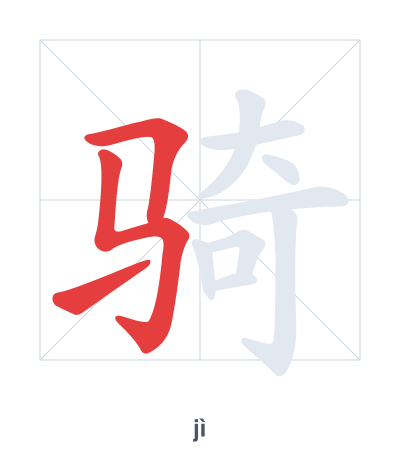
Open Hanzi Writer to see the animated stroke order and practice writing 骑 with real-time feedback.
The character 骑 (jì/qí) is written with 11 strokes. Follow the standard Chinese stroke order: top to bottom, left to right, outside before inside. The radical 马 is one of its key components.
Practice the correct stroke order with the Hanzi Writer app to see animated stroke-by-stroke guidance with real-time feedback.
骑 means To ride.
This is a polyphonic character with readings: jì, qí.
As an HSK Level 2 character, 骑 is among the first characters beginners learn.
骑 is a phono-semantic compound: the radical 马 (horse) indicates that the character relates to horses, while 奇 (qí) gives a phonetic hint to the pronunciation jì. The original meaning is 'to ride a horse', which later broadened to mean 'to ride' any animal or vehicle.
💡 Memory Tip: Picture a horse (马) with a strange (奇) saddle on its back—you climb up to ride it, and that odd saddle is what helps you remember the character for 'to ride'.
我每天骑车去学校。
wǒ měi tiān qí chē qù xué xiào
I ride a bike to school every day.
他在公园里练习骑马。
tā zài gōng yuán lǐ liàn xí qí mǎ
He is practicing horse riding in the park.
他是一个勇敢的骑士。
tā shì yí gè yǒng gǎn de qí shì
He is a brave knight.
古代的铁骑是战场上的精锐部队。
gǔ dài de tiě jì shì zhàn chǎng shàng de jīng ruì bù duì
Ancient iron cavalry were elite troops on the battlefield.
Open Hanzi Writer to see the animated stroke order and practice writing 骑 with real-time feedback.
✨ Animated stroke order · Handwriting recognition · HSK-graded practice · Free to use
骑 is made of the radical 马 (horse) on the left and the phonetic component 奇 on the right. The 马 part suggests the action involves a horse, while 奇 provides the sound and is not directly related to the meaning. Together, they form the idea of 'to ride' an animal or vehicle.