骐 (qí) means "Piebald horse" in Chinese. It has 11 strokes with the radical 马.
Rated 4.2/5 in difficulty (advanced).
Appears in 3+ common words including 骐骥 (qí jì), 骐马 (qí mǎ), 骐骥一跃 (qí jì yī yuè).
Due to its 11 strokes, Hanzi Writer's error detection shows 骐 requires focused practice — most learners need 10+ attempts for consistent accuracy.
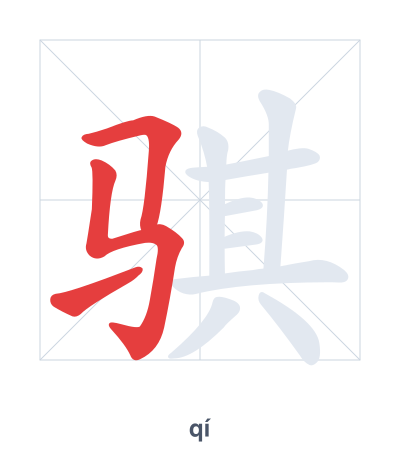
Open Hanzi Writer to see the animated stroke order and practice writing 骐 with real-time feedback.
The character 骐 (qí) is written with 11 strokes. Follow the standard Chinese stroke order: top to bottom, left to right, outside before inside. The radical 马 is one of its key components.
Practice the correct stroke order with the Hanzi Writer app to see animated stroke-by-stroke guidance with real-time feedback.
骐 means Piebald horse.
骐 is a phono-semantic compound character. The radical 马 (horse) indicates its meaning relates to horses, while the component 其 (qí) provides the pronunciation and originally meant 'basket' or 'that'. Together, they specify a piebald horse, one with a black-and-white spotted coat.
💡 Memory Tip: Picture a horse (马) with a checkered pattern (其) like a chessboard, creating the piebald spots.
骐骥能跑千里远。
qí jì néng pǎo qiān lǐ yuǎn
A fine steed can run a thousand miles.
那是一匹健壮的骐马。
nà shì yì pǐ jiàn zhuàng de qí mǎ
That is a sturdy mottled horse.
骐骥一跃,不能十步。
qí jì yī yuè bù néng shí bù
Even a fine steed cannot cover ten paces in a single leap.
Open Hanzi Writer to see the animated stroke order and practice writing 骐 with real-time feedback.
✨ Animated stroke order · Handwriting recognition · HSK-graded practice · Free to use
骐 is a phono-semantic compound: the left part 马 (horse radical) indicates the meaning relates to horses, while the right part 其 (qí) provides the pronunciation. This structure tells us that 骐 refers to a type of horse, specifically a piebald or fine steed.