瘙 (sào) means "to itch" in Chinese. It has 14 strokes with the radical 疒.
Rated 4.2/5 in difficulty (advanced).
Appears in 3+ common words including 瘙痒 (sào yǎng), 止瘙 (zhǐ sào), 瘙痒症 (sào yǎng zhèng).
Due to its 14 strokes, Hanzi Writer's error detection shows 瘙 requires focused practice — most learners need 10+ attempts for consistent accuracy.
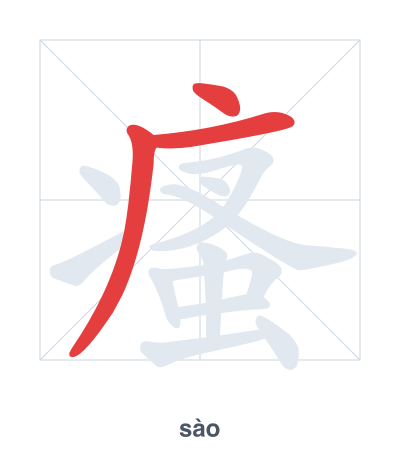
Open Hanzi Writer to see the animated stroke order and practice writing 瘙 with real-time feedback.
The character 瘙 (sào) is written with 14 strokes. Follow the standard Chinese stroke order: top to bottom, left to right, outside before inside. The radical 疒 is one of its key components.
Practice the correct stroke order with the Hanzi Writer app to see animated stroke-by-stroke guidance with real-time feedback.
瘙 means to itch.
The character 瘙 combines the illness radical 疒 (sickbed) with 蚤 (flea), indicating that an itch is often caused by flea bites. The 疒 radical suggests a health issue, while 蚤 specifies the source—a small insect that provokes scratching.
💡 Memory Tip: Imagine lying on a sickbed (疒) with a flea (蚤) biting your arm—you can't stop itching!
皮肤感到非常瘙痒。
pí fū gǎn dào fēi cháng sào yǎng
The skin feels very itchy.
这种药可以止瘙。
zhè zhǒng yào kě yǐ zhǐ sào
This medicine can stop itching.
他患有皮肤瘙痒症。
tā huàn yǒu pí fū sào yǎng zhèng
He suffers from pruritus (itchy skin).
Open Hanzi Writer to see the animated stroke order and practice writing 瘙 with real-time feedback.
✨ Animated stroke order · Handwriting recognition · HSK-graded practice · Free to use
The character 瘙 is made of the radical 疒 (illness) on top and the character 蚤 (flea) below. Fleas cause itchy bites, so the combination suggests an illness related to itching. This structure directly shows that 瘙 means "to itch" as a skin condition.