蕠 (rú) means "Madder / Tangled roots" in Chinese. It has 16 strokes with the radical 艹.
Rated 4.2/5 in difficulty (advanced).
Appears in 3+ common words including 蕠草 (rú cǎo), 根蕠 (gēn rú), 连蕠 (lián rú).
Due to its 16 strokes, Hanzi Writer's error detection shows 蕠 requires focused practice — most learners need 10+ attempts for consistent accuracy.
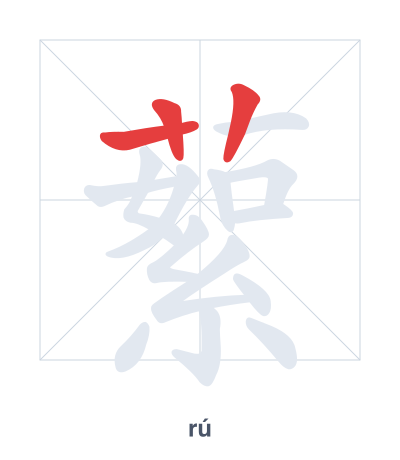
Open Hanzi Writer to see the animated stroke order and practice writing 蕠 with real-time feedback.
The character 蕠 (rú) is written with 16 strokes. Follow the standard Chinese stroke order: top to bottom, left to right, outside before inside. The radical 艹 is one of its key components.
Practice the correct stroke order with the Hanzi Writer app to see animated stroke-by-stroke guidance with real-time feedback.
蕠 means Madder / Tangled roots.
The character 蕠 combines the grass radical (艹) with 如 (rú, meaning 'like' or 'as'), indicating a plant whose roots are tangled 'like' threads. This matches its meaning as madder, a climbing plant with intertwining roots used for red dye.
💡 Memory Tip: Picture grass (艹) growing so tangled that a woman (女) is stuck trying to speak (口) from within the mess of roots.
这种蕠草很少见。
zhè zhǒng rú cǎo hěn shǎo jiàn
This kind of grass is very rare.
这种植物有根蕠。
zhè zhòng zhí wù yǒu gēn rú
This plant has tangled roots.
这里的草根连蕠。
zhè lǐ de cǎo gēn lián rú
The grass roots here are interconnected.
Open Hanzi Writer to see the animated stroke order and practice writing 蕠 with real-time feedback.
✨ Animated stroke order · Handwriting recognition · HSK-graded practice · Free to use
The character 蕠 is made of the grass radical 艹 on top and the phonetic component 如 (rú) below. The grass radical indicates that the character is related to plants, while 如 provides the pronunciation. Together, they represent a type of grass with tangled roots.