悛 (quān) means "repent" in Chinese. It has 10 strokes with the radical 忄.
Rated 4.2/5 in difficulty (advanced).
Appears in 3+ common words including 悛改 (quān gǎi), 长恶不悛 (cháng è bù quān), 悛心 (quān xīn).
Due to its 10 strokes, Hanzi Writer's error detection shows 悛 requires focused practice — most learners need 10+ attempts for consistent accuracy.
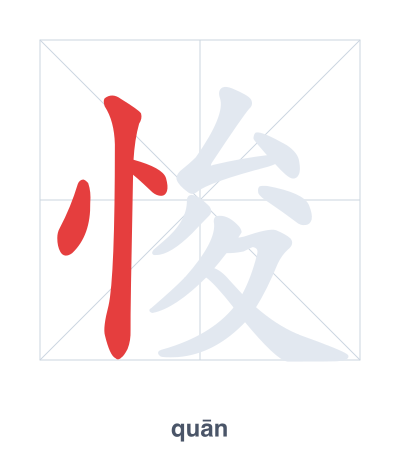
Open Hanzi Writer to see the animated stroke order and practice writing 悛 with real-time feedback.
The character 悛 (quān) is written with 10 strokes. Follow the standard Chinese stroke order: top to bottom, left to right, outside before inside. The radical 忄 is one of its key components.
Practice the correct stroke order with the Hanzi Writer app to see animated stroke-by-stroke guidance with real-time feedback.
悛 means repent.
悛 is a compound character: the left side 忄 represents the heart or emotions, while the right side 夋 (originally a pictograph of a person turning) provides phonetic and semantic hints of change. Together, they depict a 'change of heart,' which is the essence of repentance.
💡 Memory Tip: Picture a person (夋) whose heart (忄) suddenly does a U-turn to show they truly repent.
他终于有了悛改之心。
tā zhōng yú yǒu le quān gǎi zhī xīn
He finally showed a heart of repentance.
他长恶不悛,令人失望。
tā cháng è bù quān lìng rén shī wàng
He persists in his evil ways without repentance, which is disappointing.
悛心悔过是好事。
quān xīn huǐ guò shì hǎo shì
It is a good thing to repent and mend one's ways.
Open Hanzi Writer to see the animated stroke order and practice writing 悛 with real-time feedback.
✨ Animated stroke order · Handwriting recognition · HSK-graded practice · Free to use
The character combines the heart radical (忄) with the component 夋, which suggests change or alteration. Together, they convey the idea of a change of heart, which is the essence of repentance.