胠 (qū) means "Flank; to open from the side" in Chinese. It has 9 strokes with the radical 月.
Rated 4/5 in difficulty (challenging).
Appears in 3+ common words including 胠箧 (qū qiè), 胠肢 (qū zhī), 胠腋 (qū yè).
Due to its 9 strokes, Hanzi Writer's error detection shows 胠 requires focused practice — most learners need 10+ attempts for consistent accuracy.
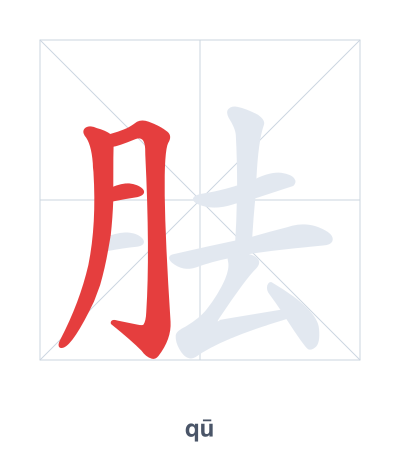
Open Hanzi Writer to see the animated stroke order and practice writing 胠 with real-time feedback.
The character 胠 (qū) is written with 9 strokes. Follow the standard Chinese stroke order: top to bottom, left to right, outside before inside. The radical 月 is one of its key components.
Practice the correct stroke order with the Hanzi Writer app to see animated stroke-by-stroke guidance with real-time feedback.
胠 means Flank; to open from the side.
The character 胠 combines the radical 月 (meat/flesh) with 去 (qù, 'to depart/remove'). The flesh radical indicates a body part, while 去 suggests the flank as the place where limbs 'depart' from the torso, or the action of opening something from its side.
💡 Memory Tip: Picture a person's side (月) with a door that says 'Go' (去) — you open it from the flank to let someone out.
他在读胠箧的故事。
tā zài dú qū qiè de gù shì
He is reading the story of 'Ransacking the Coffer'.
他的胠肢受了轻伤。
tā de qū zhī shòu le qīng shāng
He suffered a minor injury to his flank.
汗水打湿了胠腋。
hàn shuǐ dǎ shī le qū yè
Sweat soaked the armpits.
Open Hanzi Writer to see the animated stroke order and practice writing 胠 with real-time feedback.
✨ Animated stroke order · Handwriting recognition · HSK-graded practice · Free to use
胠 has two parts: the left radical 月 (meat/body) and the right part 去 (to go). The 月 radical suggests a body part, and the character's meaning "flank" refers to the side of the body. The right side 去 may hint at the action of opening from the side, like moving something aside.