腋 (yè) means "Armpit" in Chinese. It has 12 strokes with the radical 月.
Rated 4.2/5 in difficulty (advanced).
Appears in 3+ common words including 腋下 (yè xià), 腋窝 (yè wō), 腋毛 (yè máo).
Due to its 12 strokes, Hanzi Writer's error detection shows 腋 requires focused practice — most learners need 10+ attempts for consistent accuracy.
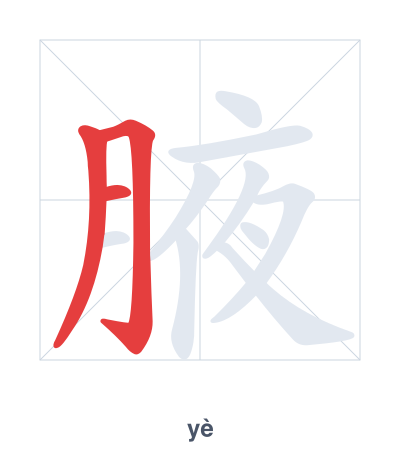
Open Hanzi Writer to see the animated stroke order and practice writing 腋 with real-time feedback.
The character 腋 (yè) is written with 12 strokes. Follow the standard Chinese stroke order: top to bottom, left to right, outside before inside. The radical 月 is one of its key components.
Practice the correct stroke order with the Hanzi Writer app to see animated stroke-by-stroke guidance with real-time feedback.
腋 means Armpit.
腋 is a phono-semantic compound: the radical 月 (flesh/body) indicates it's a body part, while 夜 (yè, 'night') supplies the pronunciation. The armpit is the hollow under the arm where the body's flesh folds.
💡 Memory Tip: Imagine a tiny bat sleeping in your armpit all night (夜), its body (月) tucked safely away.
把书夹在腋下。
bǎ shū jiā zài yè xià
Tuck the book under your arm.
他的腋窝很怕痒。
tā de yè wō hěn pà yǎng
His armpits are very ticklish.
运动员会刮腋毛。
yùn dòng yuán huì guā yè máo
Athletes shave their armpit hair.
Open Hanzi Writer to see the animated stroke order and practice writing 腋 with real-time feedback.
✨ Animated stroke order · Handwriting recognition · HSK-graded practice · Free to use
腋 is a phono-semantic compound. The left radical 月 (meat/flesh) indicates that the character relates to a body part. The right part 夜 (yè, night) gives the pronunciation and does not directly contribute to the meaning.