逑 (qiú) means "To match / Mate" in Chinese. It has 10 strokes with the radical 辶.
Rated 4.2/5 in difficulty (advanced).
Appears in 3+ common words including 好逑 (hǎo qiú), 逑合 (qiú hé), 配逑 (pèi qiú).
Due to its 10 strokes, Hanzi Writer's error detection shows 逑 requires focused practice — most learners need 10+ attempts for consistent accuracy.
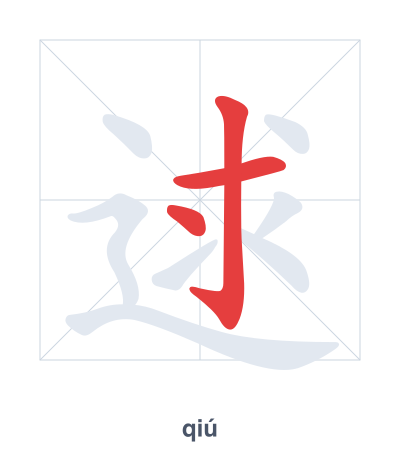
Open Hanzi Writer to see the animated stroke order and practice writing 逑 with real-time feedback.
The character 逑 (qiú) is written with 10 strokes. Follow the standard Chinese stroke order: top to bottom, left to right, outside before inside. The radical 辶 is one of its key components.
Practice the correct stroke order with the Hanzi Writer app to see animated stroke-by-stroke guidance with real-time feedback.
逑 means To match / Mate.
逑 is a phono-semantic compound. The radical 辶 (walk) suggests movement or action, while 求 (qiú, to seek) provides the pronunciation and a hint of meaning—together they depict 'going to seek' a partner, hence 'to match' or 'mate.'
💡 Memory Tip: Picture a lonely person walking (辶) toward a crowd while holding a sign that says '求 mate'—they are actively seeking a match.
窈窕淑女,君子好逑。
yǎo tiǎo shū nǚ jūn zǐ hǎo qiú
A fair and graceful lady is a fine match for a gentleman.
两人最终逑合了。
liǎng rén zuì zhōng qiú hé le
The two finally got married.
寻找合适的配逑。
xún zhǎo hé shì de pèi qiú
Looking for a suitable partner.
Open Hanzi Writer to see the animated stroke order and practice writing 逑 with real-time feedback.
✨ Animated stroke order · Handwriting recognition · HSK-graded practice · Free to use
逑 is made of two parts: the radical 辶 (walk) on the left, and 求 (to seek) on the right. The radical suggests movement or action, while 求 gives the sound and meaning of seeking. Together, they convey the idea of "walking to seek a match or mate."