鹙 (qiū) means "adjutant bird; marabou stork" in Chinese. It has 14 strokes with the radical 鸟.
Rated 4.2/5 in difficulty (advanced).
Appears in 3+ common words including 秃鹙 (tū qiū), 鹙鸟 (qiū niǎo), 大秃鹙 (dà tū qiū).
Due to its 14 strokes, Hanzi Writer's error detection shows 鹙 requires focused practice — most learners need 10+ attempts for consistent accuracy.
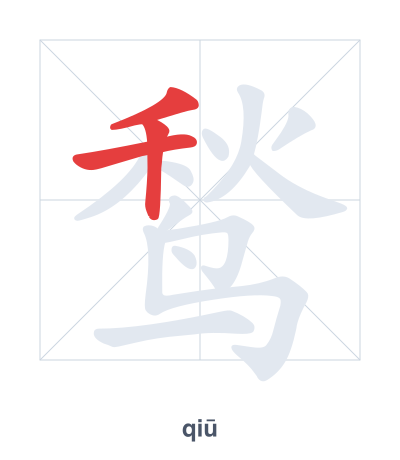
Open Hanzi Writer to see the animated stroke order and practice writing 鹙 with real-time feedback.
The character 鹙 (qiū) is written with 14 strokes. Follow the standard Chinese stroke order: top to bottom, left to right, outside before inside. The radical 鸟 is one of its key components.
Practice the correct stroke order with the Hanzi Writer app to see animated stroke-by-stroke guidance with real-time feedback.
鹙 means adjutant bird; marabou stork.
鹙 is a phono-semantic compound: the radical 鸟 (bird) indicates it's a type of bird, while 秋 (qiū, autumn) provides the pronunciation. The marabou stork is a large bird often seen in autumn, hence the combination.
💡 Memory Tip: Picture an autumn (秋) bird (鸟) — a huge marabou stork standing in a field of falling leaves, its bald head and long beak looking like a walking umbrella.
秃鹙在树上休息。
tū qiū zài shù shàng xiū xī
The marabou stork is resting in the tree.
这种鹙鸟很大。
zhè zhǒng qiū niǎo hěn dà
This kind of stork is very large.
大秃鹙在找东西吃。
dà tū qiū zài zhǎo dōng xī chī
The greater adjutant is looking for food.
Open Hanzi Writer to see the animated stroke order and practice writing 鹙 with real-time feedback.
✨ Animated stroke order · Handwriting recognition · HSK-graded practice · Free to use
鹙 is a phono-semantic compound with 秋 (qiū, autumn) on top providing the sound, and 鸟 (niǎo, bird) below showing it is a bird. The phonetic component 秋 hints at the pronunciation qiū, while the radical 鸟 indicates this character refers to a type of bird like the marabou stork.