檠 (qíng) means "lampstand" in Chinese. It has 16 strokes with the radical 木.
Rated 4.2/5 in difficulty (advanced).
Appears in 3+ common words including 灯檠 (dēng qíng), 檠架 (qíng jià), 高檠 (gāo qíng).
Due to its 16 strokes, Hanzi Writer's error detection shows 檠 requires focused practice — most learners need 10+ attempts for consistent accuracy.
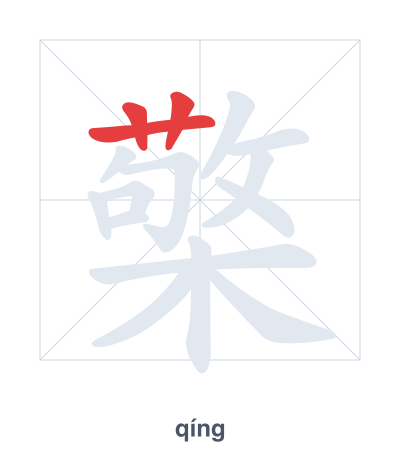
Open Hanzi Writer to see the animated stroke order and practice writing 檠 with real-time feedback.
The character 檠 (qíng) is written with 16 strokes. Follow the standard Chinese stroke order: top to bottom, left to right, outside before inside. The radical 木 is one of its key components.
Practice the correct stroke order with the Hanzi Writer app to see animated stroke-by-stroke guidance with real-time feedback.
檠 means lampstand.
檠 is a compound character combining the radical 木 (wood), indicating the lampstand's material, with 敬 (respect), which serves as a phonetic component loosely hinting at the pronunciation qíng. The wooden lampstand was a practical household item, and the character visually encodes its material and sound.
💡 Memory Tip: Imagine a wooden lampstand (木) you must handle with respect (敬) because it holds your only flame.
桌上放着一个灯檠。
zhuō shàng fàng zhe yí gè dēng qíng
There is a lampstand on the table.
这是一个木制的檠架。
zhè shì yí gè mù zhì de qíng jià
This is a wooden lampstand.
房间里摆着高檠。
fáng jiān lǐ bǎi zhe gāo qíng
A tall lampstand is placed in the room.
Open Hanzi Writer to see the animated stroke order and practice writing 檠 with real-time feedback.
✨ Animated stroke order · Handwriting recognition · HSK-graded practice · Free to use
The character 檠 is a top-bottom structure with 木 (wood) on top and 敬 (respect) below. The radical 木 indicates that the lampstand was traditionally made of wood, while 敬 gives the pronunciation qíng. Together, they create the image of a wooden object that respectfully holds a lamp.