吣 (qìn) means "to vomit / to spew / to talk nonsense" in Chinese. It has 7 strokes with the radical 口.
Rated 3.5/5 in difficulty (challenging).
Appears in 3+ common words including 吣出 (qìn chū), 吣气 (qìn qì), 吣血 (qìn xuè).
Due to its 7 strokes, Hanzi Writer's error detection shows 吣 requires focused practice — most learners need 10+ attempts for consistent accuracy.
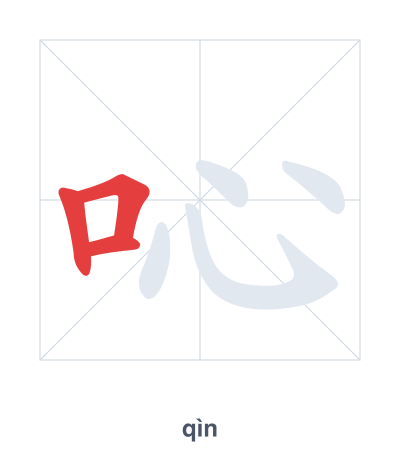
Open Hanzi Writer to see the animated stroke order and practice writing 吣 with real-time feedback.
The character 吣 (qìn) is written with 7 strokes. Follow the standard Chinese stroke order: top to bottom, left to right, outside before inside. The radical 口 is one of its key components.
Practice the correct stroke order with the Hanzi Writer app to see animated stroke-by-stroke guidance with real-time feedback.
吣 means to vomit / to spew / to talk nonsense.
吣 is a compound character combining the mouth radical 口 with 心 (heart/mind). The mouth represents the act of speaking or expelling, while 心 adds the idea of internal emotion or thought—together suggesting words or substances forced out from deep inside, like vomiting or speaking nonsense.
💡 Memory Tip: Imagine a mouth (口) violently spewing out its own heart (心)—that's the disgusting feeling of vomiting or talking pure nonsense.
他吣出了一口痰。
tā qìn chū le yī kǒu tán
He spat out a mouthful of phlegm.
别在这里乱吣气。
bié zài zhè lǐ luàn qìn qì
Don't talk nonsense here.
这种说法是吣血。
zhè zhǒng shuō fǎ shì qìn xuè
This statement is malicious slander.
Open Hanzi Writer to see the animated stroke order and practice writing 吣 with real-time feedback.
✨ Animated stroke order · Handwriting recognition · HSK-graded practice · Free to use
吣 is formed by the radical 口 (mouth) on the left and the component 心 (heart) on the right. The mouth indicates actions like speaking or vomiting, while the heart may suggest emotions, so together they mean to spew out words or matter from the heart through the mouth.