嫱 (qiáng) means "lady-in-waiting; female court official" in Chinese. It has 14 strokes with the radical 女.
Rated 4.2/5 in difficulty (advanced).
Appears in 3+ common words including 毛嫱 (máo qiáng), 嫔嫱 (pín qiáng), 嫱媛 (qiáng yuàn).
Due to its 14 strokes, Hanzi Writer's error detection shows 嫱 requires focused practice — most learners need 10+ attempts for consistent accuracy.
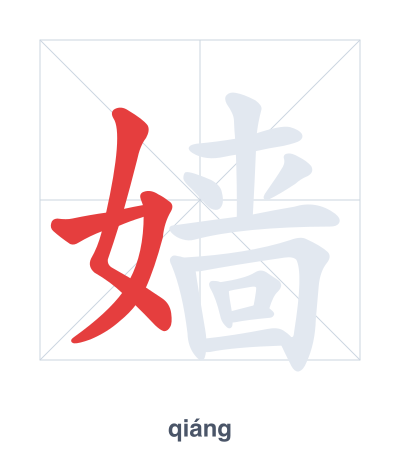
Open Hanzi Writer to see the animated stroke order and practice writing 嫱 with real-time feedback.
The character 嫱 (qiáng) is written with 14 strokes. Follow the standard Chinese stroke order: top to bottom, left to right, outside before inside. The radical 女 is one of its key components.
Practice the correct stroke order with the Hanzi Writer app to see animated stroke-by-stroke guidance with real-time feedback.
嫱 means lady-in-waiting; female court official.
嫱 combines the radical 女 (woman) with a phonetic element originally derived from 墙 (wall), indicating a female attendant who serves within palace walls. The character suggests a woman confined to the inner quarters, like a court lady behind walls.
💡 Memory Tip: Picture a lady-in-waiting (女) acting stingy (啬) by hiding treats under her gown from the other servants.
毛嫱是古代的美女。
máo qiáng shì gǔ dài de měi nǚ
Mao Qiang was a beauty in ancient times.
她们是宫里的嫔嫱。
tā men shì gōng lǐ de pín qiáng
They are concubines in the palace.
嫱媛指美丽的女子。
qiáng yuàn zhǐ měi lì de nǚ zǐ
'Qiangyuan' refers to a beautiful woman.
Open Hanzi Writer to see the animated stroke order and practice writing 嫱 with real-time feedback.
✨ Animated stroke order · Handwriting recognition · HSK-graded practice · Free to use
The character 嫱 combines the radical 女 (woman) on the left, which indicates it relates to women, and the component 墙 (qiáng, meaning wall) on the right, which gives the pronunciation qiáng. Together, they suggest a woman associated with the inner palace walls, hence a lady-in-waiting or female court official.