嫔 (pín) means "Imperial concubine." in Chinese. It has 13 strokes with the radical 女.
Rated 4.2/5 in difficulty (advanced).
Appears in 3+ common words including 嫔妃 (pín fēi), 淑嫔 (shū pín), 嫔御 (pín yù).
Due to its 13 strokes, Hanzi Writer's error detection shows 嫔 requires focused practice — most learners need 10+ attempts for consistent accuracy.
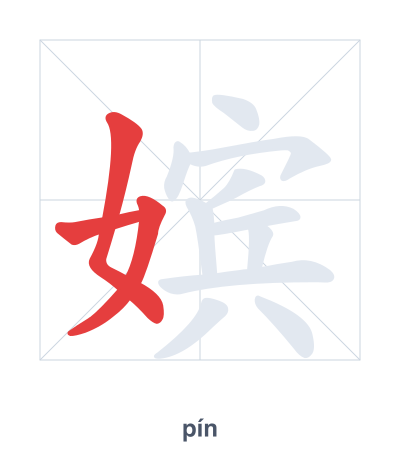
Open Hanzi Writer to see the animated stroke order and practice writing 嫔 with real-time feedback.
The character 嫔 (pín) is written with 13 strokes. Follow the standard Chinese stroke order: top to bottom, left to right, outside before inside. The radical 女 is one of its key components.
Practice the correct stroke order with the Hanzi Writer app to see animated stroke-by-stroke guidance with real-time feedback.
嫔 means Imperial concubine..
Combines the radical 女 (woman) with phonetic 宾 (guest), reflecting that an imperial concubine was a woman who came as a guest into the imperial harem.
💡 Memory Tip: Visualize a woman (女) who is a guest (宾) under the emperor's roof (宀), permanently stationed like a pin (pín) in a cushion.
宫里有很多嫔妃。
gōng lǐ yǒu hěn duō pín fēi
There are many concubines in the palace.
淑嫔住在那个宫殿里。
shū pín zhù zài nà ge gōng diàn lǐ
Concubine Shu lives in that palace.
嫔御们在花园里散步。
pín yù men zài huā yuán lǐ sàn bù
The imperial concubines are taking a walk in the garden.
Open Hanzi Writer to see the animated stroke order and practice writing 嫔 with real-time feedback.
✨ Animated stroke order · Handwriting recognition · HSK-graded practice · Free to use
The character 嫔 combines the radical 女 (woman) on the left with the phonetic component 宾 (bīn, guest) on the right. The 女 radical indicates the meaning relates to women, while 宾 suggests the role of a concubine as a 'guest' in the imperial palace — someone brought in to serve the emperor.