蜞 (qí) means "leech; crab (component)" in Chinese. It has 14 strokes with the radical 虫.
Rated 4.2/5 in difficulty (advanced).
Appears in 3+ common words including 蟛蜞 (péng qí), 蜞马 (qí mǎ), 蜞乸 (qí nǎ).
Due to its 14 strokes, Hanzi Writer's error detection shows 蜞 requires focused practice — most learners need 10+ attempts for consistent accuracy.
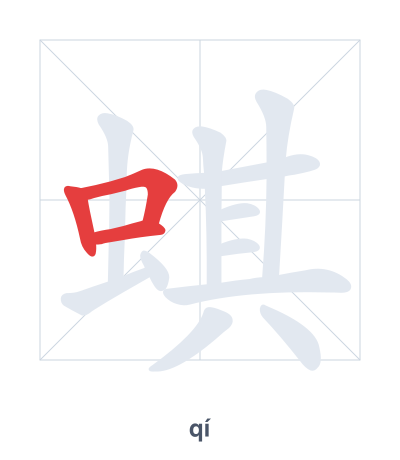
Open Hanzi Writer to see the animated stroke order and practice writing 蜞 with real-time feedback.
The character 蜞 (qí) is written with 14 strokes. Follow the standard Chinese stroke order: top to bottom, left to right, outside before inside. The radical 虫 is one of its key components.
Practice the correct stroke order with the Hanzi Writer app to see animated stroke-by-stroke guidance with real-time feedback.
蜞 means leech; crab (component).
蜞 (qí) is a phono-semantic compound: the radical 虫 (chóng, 'insect/creature') indicates it is a type of animal, while 其 (qí) provides the pronunciation. In ancient usage, 蜞 referred to a leech, a blood-sucking worm, and also appears as a component in words for certain crabs (e.g., 蟛蜞).
💡 Memory Tip: Imagine a leech (虫) saying 'I'm its (其) owner!' as it clings to your skin—the character's shape shows the bug (虫) on its (其) victim.
河边有很多小蟛蜞。
hé biān yǒu hěn duō xiǎo péng qí
There are many small crabs by the river.
蜞马在水里游。
qí mǎ zài shuǐ lǐ yóu
The water strider is swimming in the water.
岸边有几只蜞乸。
àn biān yǒu jǐ zhī qí nǎ
There are a few crabs by the shore.
Open Hanzi Writer to see the animated stroke order and practice writing 蜞 with real-time feedback.
✨ Animated stroke order · Handwriting recognition · HSK-graded practice · Free to use
蜞 is made of two parts: the left side is 虫 (insect or worm radical) and the right side is 其. The radical 虫 indicates that the character refers to a small creature like a leech or crab. The right part 其 provides the pronunciation (qí) and does not add meaning.