蟛 (péng) means "Small crab" in Chinese. It has 18 strokes with the radical 虫.
Rated 4.2/5 in difficulty (advanced).
Appears in 3+ common words including 蟛蜞 (péng qí), 抓蟛蜞 (zhuā péng qí), 蟛蜞酱 (péng qí jiàng).
Due to its 18 strokes, Hanzi Writer's error detection shows 蟛 requires focused practice — most learners need 10+ attempts for consistent accuracy.
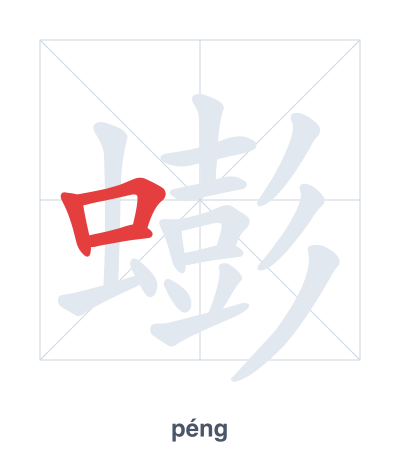
Open Hanzi Writer to see the animated stroke order and practice writing 蟛 with real-time feedback.
The character 蟛 (péng) is written with 18 strokes. Follow the standard Chinese stroke order: top to bottom, left to right, outside before inside. The radical 虫 is one of its key components.
Practice the correct stroke order with the Hanzi Writer app to see animated stroke-by-stroke guidance with real-time feedback.
蟛 means Small crab.
蟛 is a phono-semantic compound: the radical 虫 (insect/creature) indicates it is an animal, while 彭 (péng) supplies the pronunciation. The character specifically denotes a small crab, a creature associated with water and small size.
💡 Memory Tip: Picture a tiny crab (虫) with oversized claws (the top of 彭) and three little legs on each side (the three strokes of 彡) skittering sideways while making a 'peng-peng' sound with its pincers.
岸边有很多蟛蜞。
àn biān yǒu hěn duō péng qí
There are many small marsh crabs by the shore.
孩子们在抓蟛蜞。
hái zi men zài zhuā péng qí
The children are catching small crabs.
他喜欢吃蟛蜞酱。
tā xǐ huān chī péng qí jiàng
He likes eating small crab sauce.
Open Hanzi Writer to see the animated stroke order and practice writing 蟛 with real-time feedback.
✨ Animated stroke order · Handwriting recognition · HSK-graded practice · Free to use
蟛 is made of the radical 虫 (insect/creature) on the left, and 彭 on the right. The radical shows it is a type of animal, while 彭 gives the pronunciation péng and does not directly relate to the meaning of small crab.