旗 (qí) means "Flag or banner." in Chinese. It has 14 strokes with the radical 方, and is HSK Level 6.
Rated 4.2/5 in difficulty (advanced).
Harder than 67% of HSK Level 6 characters.
Appears in 3+ common words including 国旗 (guó qí), 旗子 (qí zi), 旗袍 (qí páo).
Due to its 14 strokes, Hanzi Writer's error detection shows 旗 requires focused practice — most learners need 10+ attempts for consistent accuracy.
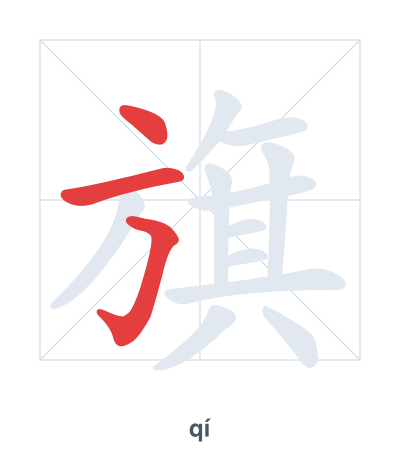
Open Hanzi Writer to see the animated stroke order and practice writing 旗 with real-time feedback.
The character 旗 (qí) is written with 14 strokes. Follow the standard Chinese stroke order: top to bottom, left to right, outside before inside. The radical 方 is one of its key components.
Practice the correct stroke order with the Hanzi Writer app to see animated stroke-by-stroke guidance with real-time feedback.
旗 means Flag or banner..
As an HSK Level 6 character, 旗 is an intermediate-level character.
旗 is a phono-semantic compound. Its radical 方 originally depicted a flag hanging from a pole, while the right part 其 (pronounced qí) provides the sound. The character thus visually represents a banner or flag on a staff.
💡 Memory Tip: Picture a square flag (方) attached to a pole that stands on a little table (其, like a stand) — that’s your banner waving in the wind.
操场上升起了国旗。
cāo chǎng shàng shēng qǐ le guó qí
The national flag was raised on the playground.
他手里拿着一面旗子。
tā shǒu lǐ ná zhe yí miàn qí zi
He is holding a flag in his hand.
她穿旗袍很漂亮。
tā chuān qí páo hěn piào liàng
She looks beautiful in a cheongsam.
Open Hanzi Writer to see the animated stroke order and practice writing 旗 with real-time feedback.
✨ Animated stroke order · Handwriting recognition · HSK-graded practice · Free to use
旗 consists of the radical 方 on the left, which originally meant a banner or flag, and 其 on the right, which gives the sound (qí). The radical 方 strongly suggests the meaning of a flag or banner, making the character easy to understand as a visual symbol of a flag.