嘁 (qī) means "Whisper; hiss." in Chinese. It has 14 strokes with the radical 口.
Rated 4.2/5 in difficulty (advanced).
Appears in 3+ common words including 嘁嘁喳喳 (qī qī zhā zhā), 嘁喳 (qī zhā), 嘁的一声 (qī de yī shēng).
Due to its 14 strokes, Hanzi Writer's error detection shows 嘁 requires focused practice — most learners need 10+ attempts for consistent accuracy.
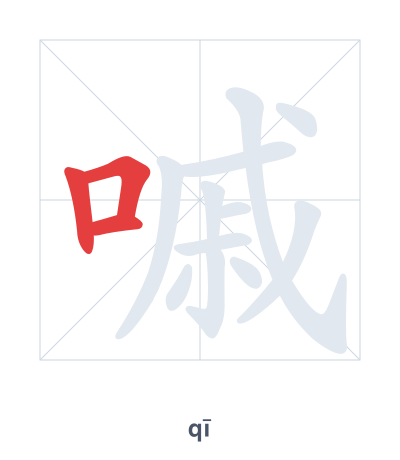
Open Hanzi Writer to see the animated stroke order and practice writing 嘁 with real-time feedback.
The character 嘁 (qī) is written with 14 strokes. Follow the standard Chinese stroke order: top to bottom, left to right, outside before inside. The radical 口 is one of its key components.
Practice the correct stroke order with the Hanzi Writer app to see animated stroke-by-stroke guidance with real-time feedback.
嘁 means Whisper; hiss..
嘁 is a phono-semantic compound. The radical 口 (mouth) indicates it relates to sounds made by the mouth, like whispering or hissing. The component 戚 (qī) provides the pronunciation and visually suggests a close relative leaning in to share a secret whisper.
💡 Memory Tip: Imagine a mouth (口) saying 'chee' softly as a close relative (戚) leans in to whisper a secret.
他们在嘁嘁喳喳说话。
tā men zài qī qī zhā zhā shuō huà
They are whispering and chattering.
别在那儿嘁喳。
bié zài nà ér qī zhā
Don't chatter over there.
他嘁的一声笑了。
tā qī de yī shēng xiào le
He gave a little chuckle.
Open Hanzi Writer to see the animated stroke order and practice writing 嘁 with real-time feedback.
✨ Animated stroke order · Handwriting recognition · HSK-graded practice · Free to use
嘁 is composed of the radical 口 (mouth) on the left, which hints at sound or speech, and the phonetic component 戚 (qī) on the right. The 口 shows it involves mouth actions, while 戚 gives the pronunciation and in this context relates to whispering or hissing sounds.