谝 (pián) means "to show off; to brag; to chat (dialect)" in Chinese. It has 11 strokes with the radical 讠.
Rated 3.9/5 in difficulty (challenging).
Appears in 3+ common words including 谝能 (pián néng), 谝闲传 (pián xián chuán), 谝客 (pián kè).
Due to its 11 strokes, Hanzi Writer's error detection shows 谝 requires focused practice — most learners need 10+ attempts for consistent accuracy.
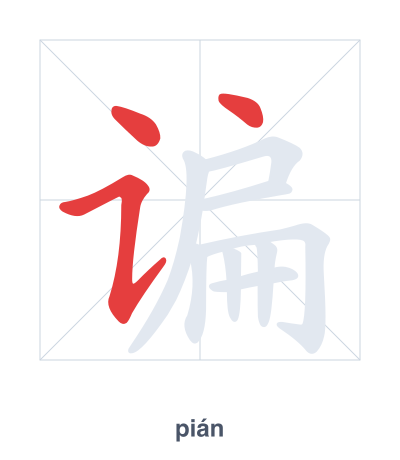
Open Hanzi Writer to see the animated stroke order and practice writing 谝 with real-time feedback.
The character 谝 (pián) is written with 11 strokes. Follow the standard Chinese stroke order: top to bottom, left to right, outside before inside. The radical 讠 is one of its key components.
Practice the correct stroke order with the Hanzi Writer app to see animated stroke-by-stroke guidance with real-time feedback.
谝 means to show off; to brag; to chat (dialect).
This compound character combines the speech radical 讠 (words) with the phonetic component 扁 (pián, meaning 'flat' or 'inscribed'). The idea is of speaking in a flat, boastful manner—showing off with words that are 'flat' or insincere, or engaging in casual chat (dialect).
💡 Memory Tip: A show-off talks (讠) so much that their ego becomes flat (扁) like a deflated tire.
他喜欢谝能。
tā xǐ huān pián néng
He likes to show off his abilities.
他们在谝闲传。
tā men zài pián xián chuán
They are chatting idly.
他是个老谝客。
tā shì gè lǎo pián kè
He is an old braggart.
Open Hanzi Writer to see the animated stroke order and practice writing 谝 with real-time feedback.
✨ Animated stroke order · Handwriting recognition · HSK-graded practice · Free to use
The character 谝 has two parts: the left side is 讠, which means speech or words, and the right side is 扁 (piān, meaning flat). Together, they suggest someone using flat or exaggerated speech to brag or chat, which matches its meanings of showing off or gossiping.