癖 (pǐ) means "habit; addiction; hobby" in Chinese. It has 18 strokes with the radical 疒.
Rated 4.2/5 in difficulty (advanced).
Appears in 3+ common words including 洁癖 (jié pǐ), 癖好 (pǐ hào), 书癖 (shū pǐ).
Due to its 18 strokes, Hanzi Writer's error detection shows 癖 requires focused practice — most learners need 10+ attempts for consistent accuracy.
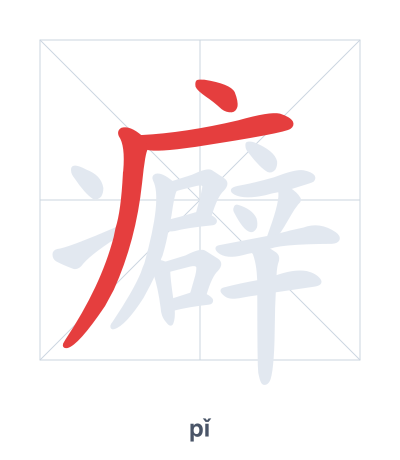
Open Hanzi Writer to see the animated stroke order and practice writing 癖 with real-time feedback.
The character 癖 (pǐ) is written with 18 strokes. Follow the standard Chinese stroke order: top to bottom, left to right, outside before inside. The radical 疒 is one of its key components.
Practice the correct stroke order with the Hanzi Writer app to see animated stroke-by-stroke guidance with real-time feedback.
癖 means habit; addiction; hobby.
It is a phono-semantic compound combining the sickness radical 疒 with 辟 (pì), which provides the pronunciation and hints at 'breaking' or 'opening up.' This suggests that a 癖 (habit or addiction) is viewed as a disease or compulsive urge that breaks one's normal behavior.
💡 Memory Tip: Picture a sick person (疒) using all their strength to break open (辟) a locked cabinet just to grab their addictive hobby gear.
他有严重的洁癖。
tā yǒu yán zhòng de jié pǐ
He is a serious clean freak.
每个人都有癖好。
měi gè rén dōu yǒu pǐ hào
Everyone has a hobby or peculiarity.
他是个老书癖。
tā shì gè lǎo shū pǐ
He is an old bibliophile.
Open Hanzi Writer to see the animated stroke order and practice writing 癖 with real-time feedback.
✨ Animated stroke order · Handwriting recognition · HSK-graded practice · Free to use
The character 癖 is composed of the radical 疒 (illness) on the left and the phonetic component 辟 on the right. The radical 疒 suggests an unhealthy or excessive state, so the character relates to strong habits or addictions that are like a disease. The right part 辟 gives the pronunciation pì but does not directly contribute to the meaning.