傩 (nuó) means "Nuo (ancient ritual to drive away evil)" in Chinese. It has 12 strokes with the radical 亻.
Rated 3.9/5 in difficulty (challenging).
Appears in 3+ common words including 傩戏 (nuó xì), 傩舞 (nuó wǔ), 傩面具 (nuó miàn jù).
Due to its 12 strokes, Hanzi Writer's error detection shows 傩 requires focused practice — most learners need 10+ attempts for consistent accuracy.
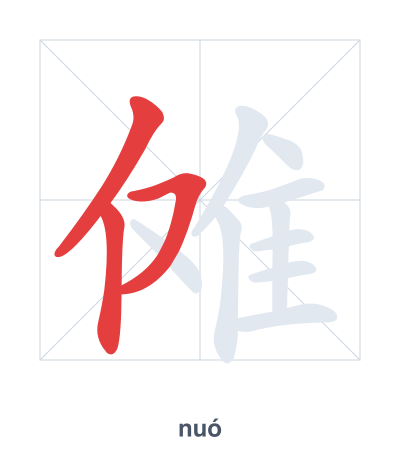
Open Hanzi Writer to see the animated stroke order and practice writing 傩 with real-time feedback.
The character 傩 (nuó) is written with 12 strokes. Follow the standard Chinese stroke order: top to bottom, left to right, outside before inside. The radical 亻 is one of its key components.
Practice the correct stroke order with the Hanzi Writer app to see animated stroke-by-stroke guidance with real-time feedback.
傩 means Nuo (ancient ritual to drive away evil).
傩 combines the person radical 亻 with 難 (difficulty/disaster), picturing a person confronting misfortune. In ancient China, a shaman wearing a mask would perform the Nuo ritual to banish evil spirits and pestilence, hence the character shows a person dealing with calamity.
💡 Memory Tip: Imagine a person (亻) wearing a fierce mask to scare away a difficult (難) demon during a noisy Nuo dance.
这里的傩戏很有名。
zhè lǐ de nuó xì hěn yǒu míng
The Nuo opera here is very famous.
他们在跳傩舞。
tā men zài tiào nuó wǔ
They are performing the Nuo dance.
这个傩面具很漂亮。
zhè ge nuó miàn jù hěn piào liàng
This Nuo opera mask is very beautiful.
Open Hanzi Writer to see the animated stroke order and practice writing 傩 with real-time feedback.
✨ Animated stroke order · Handwriting recognition · HSK-graded practice · Free to use
The character 傩 is made of two parts: the left radical 亻 (meaning 'person') and the right side 难 (pronounced nán, meaning 'difficult'). Together they suggest a person performing a ritual to drive away difficulties (evil spirits), which is the ancient Nuo ceremony.