侬 (nóng) means "You (dialect, e.g., Shanghainese) / I (literary)" in Chinese. It has 8 strokes with the radical 亻.
Rated 3.4/5 in difficulty (challenging).
Appears in 3+ common words including 侬好 (nóng hǎo), 侬家 (nóng jiā), 吴侬软语 (wú nóng ruǎn yǔ).
Due to its 8 strokes, Hanzi Writer's error detection shows 侬 requires focused practice — most learners need 10+ attempts for consistent accuracy.
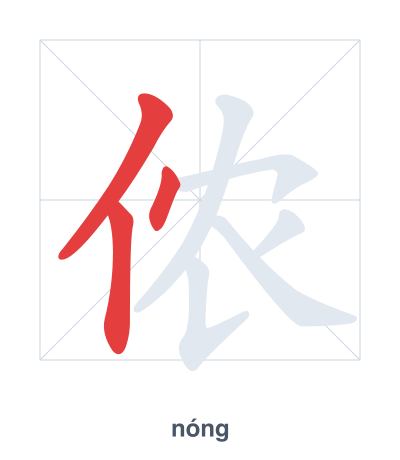
Open Hanzi Writer to see the animated stroke order and practice writing 侬 with real-time feedback.
The character 侬 (nóng) is written with 8 strokes. Follow the standard Chinese stroke order: top to bottom, left to right, outside before inside. The radical 亻 is one of its key components.
Practice the correct stroke order with the Hanzi Writer app to see animated stroke-by-stroke guidance with real-time feedback.
侬 means You (dialect, e.g., Shanghainese) / I (literary).
侬 is a compound character combining the radical 亻 (person) with 农 (agriculture/farmer). Originally, it referred to a person who farms, but in Wu dialects like Shanghainese, it came to mean 'you' or 'I' as a familiar pronoun. The farmer component visually suggests a person connected to the land, reflecting the dialectal shift to personal address.
💡 Memory Tip: Picture a farmer (农) saying 'You!' while pointing at you with their hand (亻), blending the agricultural worker with the dialect pronoun.
侬好,上海!
nóng hǎo shàng hǎi
Hello, Shanghai!
侬家住在上海。
nóng jiā zhù zài shàng hǎi
I live in Shanghai.
这是吴侬软语。
zhè shì wú nóng ruǎn yǔ
This is the soft and melodic Wu dialect.
Open Hanzi Writer to see the animated stroke order and practice writing 侬 with real-time feedback.
✨ Animated stroke order · Handwriting recognition · HSK-graded practice · Free to use
侬 is made of the radical 亻 (person) on the left and the character 农 (nóng, farming) on the right. The person radical gives it a human-related meaning, while 农 provides the pronunciation. Together, they create a dialect word for 'you' or 'I' depending on region.