吴 (wú) means "Wu (a surname)" in Chinese. It has 7 strokes with the radical 口.
Rated 3.5/5 in difficulty (challenging).
Appears in 3+ common words including 吴先生 (wú xiān shēng), 吴语 (wú yǔ), 东吴 (dōng wú).
Due to its 7 strokes, Hanzi Writer's error detection shows 吴 requires focused practice — most learners need 10+ attempts for consistent accuracy.
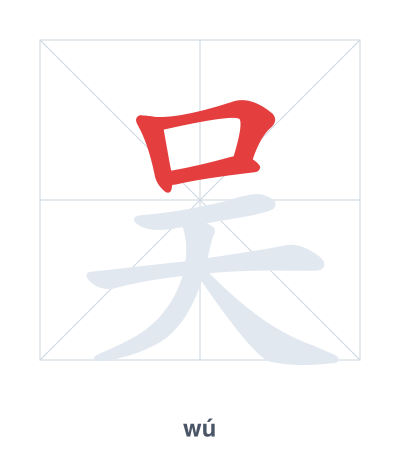
Open Hanzi Writer to see the animated stroke order and practice writing 吴 with real-time feedback.
The character 吴 (wú) is written with 7 strokes. Follow the standard Chinese stroke order: top to bottom, left to right, outside before inside. The radical 口 is one of its key components.
Practice the correct stroke order with the Hanzi Writer app to see animated stroke-by-stroke guidance with real-time feedback.
吴 means Wu (a surname).
Originally depicted a person (夨) with a mouth (口), meaning to shout loudly. Over time, the form simplified to 口 (mouth) and 天 (sky), and the character became the surname Wu, derived from the ancient state of Wu.
💡 Memory Tip: Picture a big mouth (口) under the sky (天) shouting "Wu!"—that's your surname.
吴先生是我的老师。
wú xiān shēng shì wǒ de lǎo shī
Mr. Wu is my teacher.
他会说一点吴语。
tā huì shuō yì diǎn wú yǔ
He can speak a little Wu Chinese.
他喜欢东吴的历史。
tā xǐ huān dōng wú de lì shǐ
He likes the history of Eastern Wu.
Open Hanzi Writer to see the animated stroke order and practice writing 吴 with real-time feedback.
✨ Animated stroke order · Handwriting recognition · HSK-graded practice · Free to use
吴 is composed of two parts: the top part 口 (mouth) and the bottom part 天 (sky or heaven). However, this character primarily functions as a surname and does not carry a literal meaning derived from its components, so the structure is best seen as a phonetic or conventional combination.