鲵 (ní) means "Giant salamander" in Chinese. It has 16 strokes with the radical 鱼.
Rated 4.2/5 in difficulty (advanced).
Appears in 3+ common words including 大鲵 (dà ní), 鲵鱼 (ní yú), 小鲵 (xiǎo ní).
Due to its 16 strokes, Hanzi Writer's error detection shows 鲵 requires focused practice — most learners need 10+ attempts for consistent accuracy.
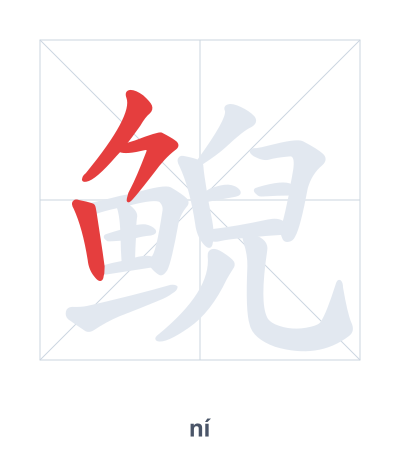
Open Hanzi Writer to see the animated stroke order and practice writing 鲵 with real-time feedback.
The character 鲵 (ní) is written with 16 strokes. Follow the standard Chinese stroke order: top to bottom, left to right, outside before inside. The radical 鱼 is one of its key components.
Practice the correct stroke order with the Hanzi Writer app to see animated stroke-by-stroke guidance with real-time feedback.
鲵 means Giant salamander.
鲵 is a phono-semantic compound: the radical 鱼 (fish) indicates it is an aquatic animal, while 兒 (ní, meaning 'child') provides the sound. This character was chosen because giant salamanders make a crying sound similar to a baby, so the 'child' component hints at their distinctive call.
💡 Memory Tip: Imagine a giant salamander with a fish body (鱼) and a baby's crying face (兒) because it sounds like a child.
大鲵是中国的保护动物。
dà ní shì zhōng guó de bǎo hù dòng wù
The giant salamander is a protected animal in China.
鲵鱼的声音像小孩哭声。
ní yú de shēng yīn xiàng xiǎo hái kū shēng
The sound of a giant salamander is like a baby's cry.
我们在溪流里发现了小鲵。
wǒ men zài xī liú lǐ fā xiàn le xiǎo ní
We found a salamander in the stream.
Open Hanzi Writer to see the animated stroke order and practice writing 鲵 with real-time feedback.
✨ Animated stroke order · Handwriting recognition · HSK-graded practice · Free to use
The character 鲵 consists of the fish radical 鱼 on the left and 兒 (meaning child) on the right. The fish radical shows it is an aquatic animal, while 兒 hints that the giant salamander's cry sounds like a crying child. This combination creates the meaning "giant salamander."