猊 (ní) means "lion-like mythical beast" in Chinese. It has 11 strokes with the radical 犭.
Rated 4.2/5 in difficulty (advanced).
Appears in 3+ common words including 狻猊 (suān ní), 猊座 (ní zuò), 猊口 (ní kǒu).
Due to its 11 strokes, Hanzi Writer's error detection shows 猊 requires focused practice — most learners need 10+ attempts for consistent accuracy.
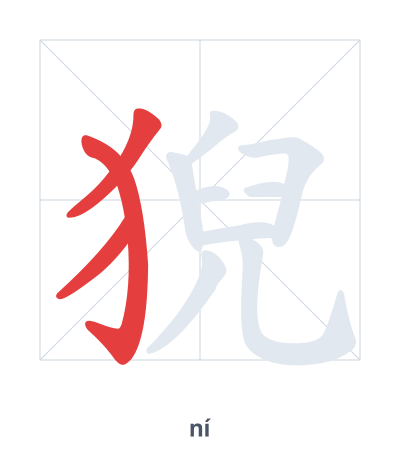
Open Hanzi Writer to see the animated stroke order and practice writing 猊 with real-time feedback.
The character 猊 (ní) is written with 11 strokes. Follow the standard Chinese stroke order: top to bottom, left to right, outside before inside. The radical 犭 is one of its key components.
Practice the correct stroke order with the Hanzi Writer app to see animated stroke-by-stroke guidance with real-time feedback.
猊 means lion-like mythical beast.
The character 猊 is a compound character combining the radical 犭, indicating an animal or beast, with 兒 (child) as a phonetic component. This phonetic hint suggests the pronunciation 'ní' for this mythical lion-like beast, often seen in Chinese art as a guardian figure.
💡 Memory Tip: Picture a fierce beast (犭) with the face of a child (兒) that sits like a stone lion at a temple gate, roaring silently.
狻猊是传说中的兽。
suān ní shì chuán shuō zhōng de shòu
The Suanni is a mythical beast.
佛像放在猊座上。
fó xiàng fàng zài ní zuò shàng
The Buddha statue is placed on the lion pedestal.
香炉上有个猊口。
xiāng lú shàng yǒu gè ní kǒu
There is a Suanni mouth on the incense burner.
Open Hanzi Writer to see the animated stroke order and practice writing 猊 with real-time feedback.
✨ Animated stroke order · Handwriting recognition · HSK-graded practice · Free to use
The left part 犭 is the 'beast' radical, indicating it refers to an animal. The right part 兒 (ní) gives the pronunciation and does not relate to the meaning. Together, they form a character for a mythical lion-like beast.