蘑 (mó) means "mushroom" in Chinese. It has 19 strokes with the radical 艹, and is HSK Level 7.
Rated 4.2/5 in difficulty (advanced).
Harder than 88% of HSK Level 7 characters.
Appears in 3+ common words including 蘑菇 (mó gū), 采蘑菇 (cǎi mó gū), 蘑菇汤 (mó gū tāng).
Due to its 19 strokes, Hanzi Writer's error detection shows 蘑 requires focused practice — most learners need 10+ attempts for consistent accuracy.
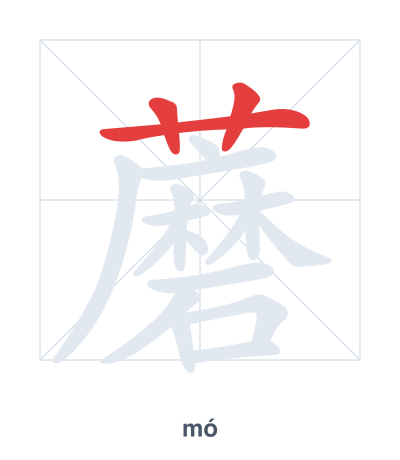
Open Hanzi Writer to see the animated stroke order and practice writing 蘑 with real-time feedback.
The character 蘑 (mó) is written with 19 strokes. Follow the standard Chinese stroke order: top to bottom, left to right, outside before inside. The radical 艹 is one of its key components.
Practice the correct stroke order with the Hanzi Writer app to see animated stroke-by-stroke guidance with real-time feedback.
蘑 means mushroom.
As an HSK Level 7 character, 蘑 is an intermediate-level character.
蘑 is a phono-semantic compound: the top radical 艹 (grass/plant) indicates it's a type of fungus, while the lower part 磨 (mó, 'to grind') provides the pronunciation. Despite its name, mushrooms are not ground plants but rather fungi that often appear in grassy or wooded areas.
💡 Memory Tip: Imagine a mushroom (艹) growing on a stone (石) covered with a hemp cloth (麻) to keep it damp—that's your 蘑.
我喜欢吃蘑菇。
wǒ xǐ huān chī mó gū
I like eating mushrooms.
我们去森林里采蘑菇。
wǒ men qù sēn lín lǐ cǎi mó gū
Let's go pick mushrooms in the forest.
这碗蘑菇汤很好喝。
zhè wǎn mó gū tāng hěn hǎo hē
This bowl of mushroom soup is delicious.
Open Hanzi Writer to see the animated stroke order and practice writing 蘑 with real-time feedback.
✨ Animated stroke order · Handwriting recognition · HSK-graded practice · Free to use
The character 蘑 combines the radical 艹 (grass/plant) on top with 磨 (mó) below. The 艹 radical shows that 蘑 is a type of plant, while 磨 provides the pronunciation and hints at the idea of grinding, since mushrooms often grow in damp, earthy places. Together, they create a character that specifically means "mushroom" in Chinese.