薰 (xūn) means "Fragrance / To perfume" in Chinese. It has 17 strokes with the radical 艹.
Rated 4.2/5 in difficulty (advanced).
Appears in 3+ common words including 薰衣草 (xūn yī cǎo), 薰陶 (xūn táo), 薰风 (xūn fēng).
Due to its 17 strokes, Hanzi Writer's error detection shows 薰 requires focused practice — most learners need 10+ attempts for consistent accuracy.
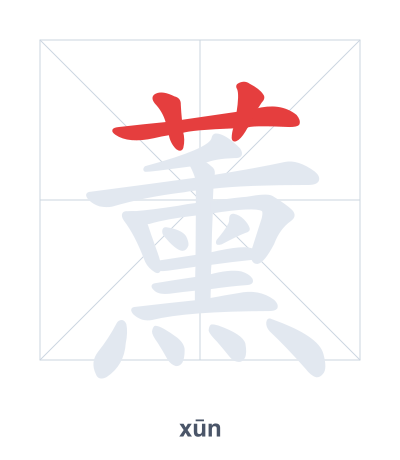
Open Hanzi Writer to see the animated stroke order and practice writing 薰 with real-time feedback.
The character 薰 (xūn) is written with 17 strokes. Follow the standard Chinese stroke order: top to bottom, left to right, outside before inside. The radical 艹 is one of its key components.
Practice the correct stroke order with the Hanzi Writer app to see animated stroke-by-stroke guidance with real-time feedback.
薰 means Fragrance / To perfume.
薰 combines the grass radical 艹 with 熏 (smoke, to fumigate), suggesting fragrant herbs that release their scent when burned or crushed. The earliest forms showed aromatic plants used in rituals, with the lower part originally depicting smoke rising from incense.
💡 Memory Tip: Imagine a bundle of grass (艹) on top of a smoky incense burner (熏) filling the air with sweet fragrance.
薰衣草的味道很好闻。
xūn yī cǎo de wèi dào hěn hǎo wén
Lavender smells very good.
他从小受艺术薰陶。
tā cóng xiǎo shòu yì shù xūn táo
He has been influenced by art since childhood.
夏日的薰风很凉爽。
xià rì de xūn fēng hěn liáng shuǎng
The warm summer breeze is very pleasant.
Open Hanzi Writer to see the animated stroke order and practice writing 薰 with real-time feedback.
✨ Animated stroke order · Handwriting recognition · HSK-graded practice · Free to use
薰 is a phono-semantic compound: the top radical 艹 means grass or plant, and the bottom part 熏 provides the sound (xūn) and also hints at the process of smoking or perfuming. Together, they suggest a plant with a strong fragrance, often used for scenting or perfuming.