薶 (mái) means "To bury / To hide" in Chinese. It has 18 strokes with the radical 艹.
Rated 4.2/5 in difficulty (advanced).
Appears in 3+ common words including 薶藏 (mái cáng), 薶没 (mái méi), 薶首 (mái shǒu).
Due to its 18 strokes, Hanzi Writer's error detection shows 薶 requires focused practice — most learners need 10+ attempts for consistent accuracy.
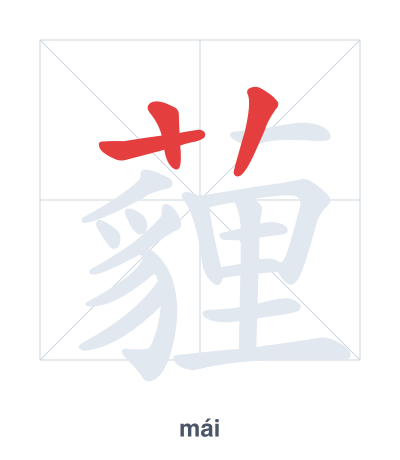
Open Hanzi Writer to see the animated stroke order and practice writing 薶 with real-time feedback.
The character 薶 (mái) is written with 18 strokes. Follow the standard Chinese stroke order: top to bottom, left to right, outside before inside. The radical 艹 is one of its key components.
Practice the correct stroke order with the Hanzi Writer app to see animated stroke-by-stroke guidance with real-time feedback.
薶 means To bury / To hide.
This character combines the grass radical (艹) with 貍 (lí, a wildcat or badger). The imagery suggests something hidden or buried beneath vegetation, as if covered by grass, linking to the meaning 'to bury' or 'to hide'.
💡 Memory Tip: Picture a wildcat (貍) burying itself under a pile of grass (艹) to hide from hunters.
古书被薶藏在地下。
gǔ shū bèi mái cáng zài dì xià
Ancient books were buried underground.
他的才华不该被薶没。
tā de cái huá bù gāi bèi mái méi
His talent should not be buried.
他在图书馆薶首苦读。
tā zài tú shū guǎn mái shǒu kǔ dú
He is burying his head in his books in the library.
Open Hanzi Writer to see the animated stroke order and practice writing 薶 with real-time feedback.
✨ Animated stroke order · Handwriting recognition · HSK-graded practice · Free to use
薶 is composed of the radical 艹 (grass) on top and 貍 (wildcat) underneath. The grass suggests something covered or hidden, while 貍 evokes the idea of an animal lurking or burying itself, together forming the meaning 'to bury' or 'to hide'.