糢 (mó) means "Blurry / Vague" in Chinese. It has 17 strokes with the radical 米.
Rated 4.2/5 in difficulty (advanced).
Appears in 3+ common words including 糢糊 (mó hú), 糢糊不清 (mó hú bù qīng), 视线糢糊 (shì xiàn mó hú).
Due to its 17 strokes, Hanzi Writer's error detection shows 糢 requires focused practice — most learners need 10+ attempts for consistent accuracy.
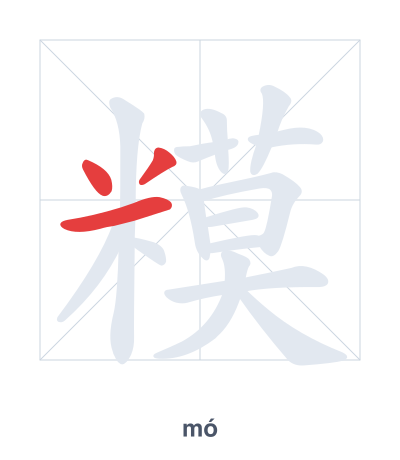
Open Hanzi Writer to see the animated stroke order and practice writing 糢 with real-time feedback.
The character 糢 (mó) is written with 17 strokes. Follow the standard Chinese stroke order: top to bottom, left to right, outside before inside. The radical 米 is one of its key components.
Practice the correct stroke order with the Hanzi Writer app to see animated stroke-by-stroke guidance with real-time feedback.
糢 means Blurry / Vague.
糢 is a compound character: the radical 米 (rice) suggests small particles that can obscure vision, and 莫 (mò) provides the sound while also hinting at obscurity (莫 meaning 'not' or 'do not'). Together they depict something blurry or vague, like seeing through a haze of rice dust.
💡 Memory Tip: Picture a blurry photo of rice (米) with the word '莫' (no) stamped across it, meaning you cannot see clearly.
这张照片很糢糊。
zhè zhāng zhào piān hěn mó hú
This photo is very blurry.
他的字写得糢糊不清。
tā de zì xiě dé mó hú bù qīng
His handwriting is blurry and illegible.
我的视线变得很糢糊。
wǒ de shì xiàn biàn dé hěn mó hú
My vision has become blurred.
Open Hanzi Writer to see the animated stroke order and practice writing 糢 with real-time feedback.
✨ Animated stroke order · Handwriting recognition · HSK-graded practice · Free to use
The character 糢 is made of the radical 米 (rice/grain) on the left and the phonetic component 莫 on the right. 莫 means "do not" or "none" and hints at the sound mó, while 米 suggests something related to texture or appearance. Together, they create the idea of something indistinct or blurry, like grains seen unclearly.