咩 (miē) means "baa (sound of a sheep)" in Chinese. It has 9 strokes with the radical 口.
Rated 4/5 in difficulty (challenging).
Appears in 3+ common words including 咩咩 (miē miē), 咩咩声 (miē miē shēng), 羊咩咩 (yáng miē miē).
Due to its 9 strokes, Hanzi Writer's error detection shows 咩 requires focused practice — most learners need 10+ attempts for consistent accuracy.
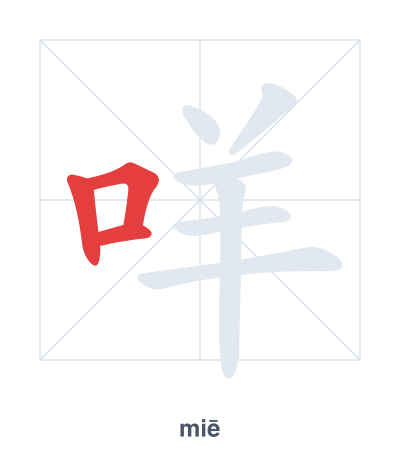
Open Hanzi Writer to see the animated stroke order and practice writing 咩 with real-time feedback.
The character 咩 (miē) is written with 9 strokes. Follow the standard Chinese stroke order: top to bottom, left to right, outside before inside. The radical 口 is one of its key components.
Practice the correct stroke order with the Hanzi Writer app to see animated stroke-by-stroke guidance with real-time feedback.
咩 means baa (sound of a sheep).
咩 is a compound character combining the mouth radical (口) with 羊 (sheep) as a phonetic component, indicating the sound a sheep makes. The mouth radical shows it's a sound-related word, while 羊 provides the pronunciation (miē).
💡 Memory Tip: Imagine a sheep (羊) opening its mouth (口) wide to let out a loud 'Baa!'
小羊咩咩地叫。
xiǎo yáng miē miē dì jiào
The lamb is bleating.
远处传来咩咩声。
yuǎn chù chuán lái miē miē shēng
Bleating sounds came from the distance.
我喜欢羊咩咩。
wǒ xǐ huān yáng miē miē
I like little sheep.
Open Hanzi Writer to see the animated stroke order and practice writing 咩 with real-time feedback.
✨ Animated stroke order · Handwriting recognition · HSK-graded practice · Free to use
咩 is made of two parts: the left side 口 (mouth) and the right side 羊 (sheep). The mouth radical shows it represents a sound, and the sheep component tells you the sound comes from a sheep — the "baa" sound. Together, 咩 directly mimics the bleating noise of sheep.