莽 (mǎng) means "Vast / Reckless / Wild" in Chinese. It has 10 strokes with the radical 艹, and is HSK Level 7.
Rated 4.2/5 in difficulty (advanced).
Harder than 86% of HSK Level 7 characters.
Appears in 3+ common words including 莽撞 (mǎng zhuàng), 草莽 (cǎo mǎng), 莽原 (mǎng yuán).
Due to its 10 strokes, Hanzi Writer's error detection shows 莽 requires focused practice — most learners need 10+ attempts for consistent accuracy.
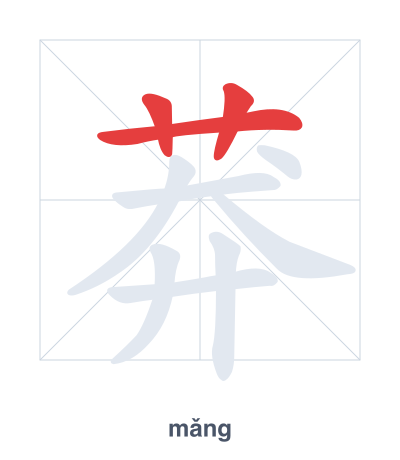
Open Hanzi Writer to see the animated stroke order and practice writing 莽 with real-time feedback.
The character 莽 (mǎng) is written with 10 strokes. Follow the standard Chinese stroke order: top to bottom, left to right, outside before inside. The radical 艹 is one of its key components.
Practice the correct stroke order with the Hanzi Writer app to see animated stroke-by-stroke guidance with real-time feedback.
莽 means Vast / Reckless / Wild.
As an HSK Level 7 character, 莽 is an intermediate-level character.
莽 combines the radical 艹 (grass) with 犬 (dog), depicting a dog dashing through thick undergrowth—this image conveys the character's meanings of wild, overgrown vegetation and reckless behavior.
💡 Memory Tip: Picture a dog (犬) wildly crashing through a dense patch of grass (艹), trampling everything in its path.
别这么莽撞。
bié zhè me mǎng zhuàng
Don't be so reckless.
他是个草莽英雄。
tā shì gè cǎo mǎng yīng xióng
He is a grassroots hero.
莽原上一片绿色。
mǎng yuán shàng yī piàn lǜ sè
The vast plain is covered in green.
Open Hanzi Writer to see the animated stroke order and practice writing 莽 with real-time feedback.
✨ Animated stroke order · Handwriting recognition · HSK-graded practice · Free to use
The character 莽 has the grass radical 艹 on top, which immediately relates to plants or wild growth. Below it is a combination of 大 (big) and 廾 (two hands), suggesting something large or unrefined. Together, the parts evoke the image of overgrown, wild grass that is vast and unruly.