镙 (luó) means "screw" in Chinese. It has 16 strokes with the radical 钅.
Rated 4.2/5 in difficulty (advanced).
Appears in 3+ common words including 镙丝 (luó sī), 镙母 (luó mǔ), 镙钉 (luó dīng).
Due to its 16 strokes, Hanzi Writer's error detection shows 镙 requires focused practice — most learners need 10+ attempts for consistent accuracy.
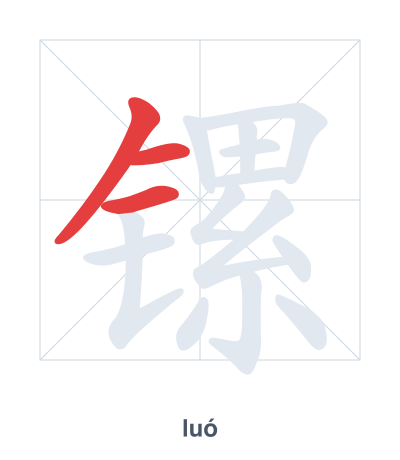
Open Hanzi Writer to see the animated stroke order and practice writing 镙 with real-time feedback.
The character 镙 (luó) is written with 16 strokes. Follow the standard Chinese stroke order: top to bottom, left to right, outside before inside. The radical 钅 is one of its key components.
Practice the correct stroke order with the Hanzi Writer app to see animated stroke-by-stroke guidance with real-time feedback.
镙 means screw.
镙 is a phono-semantic compound formed by the radical 钅 (metal, indicating the material of a screw) and the phonetic component 累 (léi, 'to accumulate' or 'to tie'), which hints at the screw's function of binding parts together. The character's right side visually suggests winding or layering, like the threads of a screw.
💡 Memory Tip: Picture a metal screw (钅) covered in a spiral of sticky, tangled wires (累) that you must tighten to hold everything together.
这个镙丝松了。
zhè ge luó sī sōng le
This screw is loose.
我需要一个镙母。
wǒ xū yào yí gè luó mǔ
I need a nut.
墙上有几个镙钉。
qiáng shàng yǒu jǐ gè luó dīng
There are several screws on the wall.
Open Hanzi Writer to see the animated stroke order and practice writing 镙 with real-time feedback.
✨ Animated stroke order · Handwriting recognition · HSK-graded practice · Free to use
The character 镙 combines the metal radical 钅 on the left with 累 on the right. The metal radical shows that it relates to metal objects, and the right side provides the pronunciation luó. Together they mean "screw," a small metal fastener.