偻 (lóu/lǚ) means "Hunchbacked / Stooped" in Chinese. It has 11 strokes with the radical 亻.
Rated 3.9/5 in difficulty (challenging).
Appears in 2+ common words including 伛偻 (yǔ lǚ), 佝偻 (gōu lóu).
Due to its 11 strokes, Hanzi Writer's error detection shows 偻 requires focused practice — most learners need 10+ attempts for consistent accuracy.
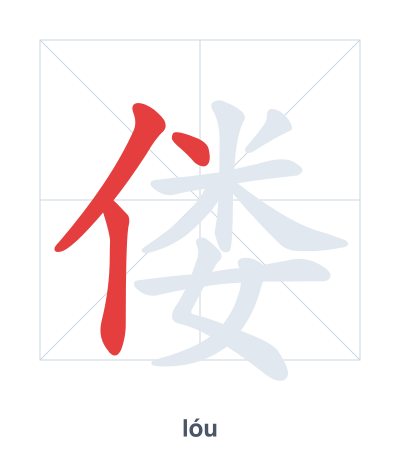
Open Hanzi Writer to see the animated stroke order and practice writing 偻 with real-time feedback.
The character 偻 (lóu/lǚ) is written with 11 strokes. Follow the standard Chinese stroke order: top to bottom, left to right, outside before inside. The radical 亻 is one of its key components.
Practice the correct stroke order with the Hanzi Writer app to see animated stroke-by-stroke guidance with real-time feedback.
偻 means Hunchbacked / Stooped.
This is a polyphonic character with readings: lóu, lǚ.
偻 is a phono-semantic compound combining the radical 亻 (person) with the phonetic component 婁 (lóu). The person radical indicates the meaning relates to a person, and the character depicts someone with a permanently bent back, like a hunchback.
💡 Memory Tip: Picture a person (亻) carrying a heavy basket (婁) on their back, causing them to stoop and become hunchbacked.
那位老人的腰已经有些伛偻了。
nà wèi lǎo rén de yāo yǐ jīng yǒu xiē yǔ lǚ le
The elderly man's back has become somewhat hunched.
长期营养不良可能会导致儿童患上佝偻病。
cháng qī yíng yǎng bù liáng kě néng huì dǎo zhì ér tóng huàn shàng gōu lóu bìng
Long-term malnutrition can lead to rickets in children.
Open Hanzi Writer to see the animated stroke order and practice writing 偻 with real-time feedback.
✨ Animated stroke order · Handwriting recognition · HSK-graded practice · Free to use
偻 is made of the radical 亻 (person) on the left, and the phonetic component 婁 (lóu) on the right. The person radical shows this character describes a human condition, while the right side provides the sound and a visual hint of bending or twisting, matching the hunchbacked meaning.