佝 (gōu) means "rickets (related to)" in Chinese. It has 7 strokes with the radical 亻.
Rated 3.2/5 in difficulty (challenging).
Appears in 3+ common words including 佝偻 (gōu lóu), 佝偻病 (gōu lóu bìng), 佝偻着 (gōu lóu zhe).
Due to its 7 strokes, Hanzi Writer's error detection shows 佝 requires focused practice — most learners need 10+ attempts for consistent accuracy.
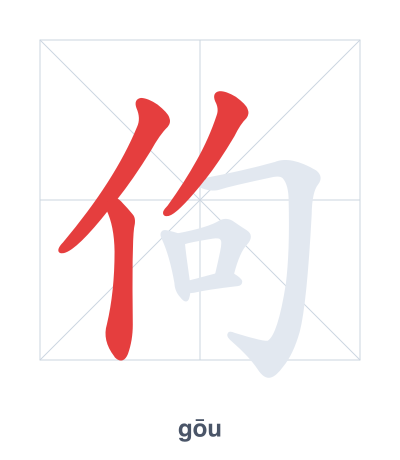
Open Hanzi Writer to see the animated stroke order and practice writing 佝 with real-time feedback.
The character 佝 (gōu) is written with 7 strokes. Follow the standard Chinese stroke order: top to bottom, left to right, outside before inside. The radical 亻 is one of its key components.
Practice the correct stroke order with the Hanzi Writer app to see animated stroke-by-stroke guidance with real-time feedback.
佝 means rickets (related to).
佝 is a phono-semantic compound: the radical 亻 (person) indicates a human, and 句 (gōu) provides the sound while also suggesting a curved or bent shape, as in a hook. The character describes a person with a deformed, hunched posture or bowed legs, characteristic of rickets.
💡 Memory Tip: Picture a person (亻) bent over like a hook (句) because their spine is curved from rickets.
老人的背影很佝偻。
lǎo rén de bèi yǐng hěn gōu lóu
The elderly person's back is very hunched.
孩子要预防佝偻病。
hái zi yào yù fáng gōu lóu bìng
Children need to prevent rickets.
他佝偻着腰走路。
tā gōu lóu zhe yāo zǒu lù
He walks with a hunched back.
Open Hanzi Writer to see the animated stroke order and practice writing 佝 with real-time feedback.
✨ Animated stroke order · Handwriting recognition · HSK-graded practice · Free to use
佝 is made of the radical 亻 (person) on the left and the component 句 (jù, meaning 'sentence' or 'hook') on the right. The radical indicates a person, while 句 suggests a curved shape — together they depict a person with a bent or hunched back, which relates to rickets. This structure shows the character's origin in describing a physical deformity.