琉 (liú) means "Glazed glass" in Chinese. It has 11 strokes with the radical 王.
Rated 4.2/5 in difficulty (advanced).
Appears in 3+ common words including 琉璃 (liú lí), 琉璃瓦 (liú lí wǎ), 琉璃球 (liú lí qiú).
Due to its 11 strokes, Hanzi Writer's error detection shows 琉 requires focused practice — most learners need 10+ attempts for consistent accuracy.
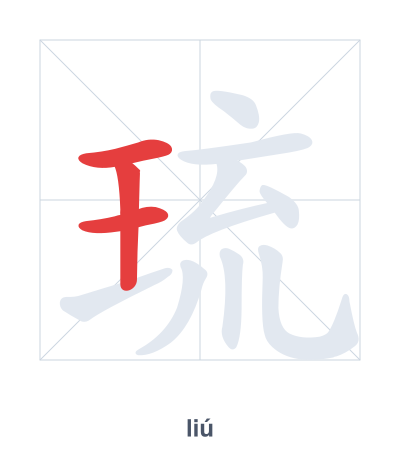
Open Hanzi Writer to see the animated stroke order and practice writing 琉 with real-time feedback.
The character 琉 (liú) is written with 11 strokes. Follow the standard Chinese stroke order: top to bottom, left to right, outside before inside. The radical 王 is one of its key components.
Practice the correct stroke order with the Hanzi Writer app to see animated stroke-by-stroke guidance with real-time feedback.
琉 means Glazed glass.
琉 is a phono-semantic compound. Its radical 王 (jade) hints at the stone-like, glossy quality of glazed glass, while the phonetic component 㐬 (a variant of 流 liú 'flow') suggests the smooth, fluid appearance of the glaze. Together, the character evokes the image of a precious, flowing jade-like material—originally referring to a type of colored glass or gemstone.
💡 Memory Tip: Imagine a king (王) pouring liquid glass (the flowing strokes of 㐬) to shape a shiny, glazed bottle.
这个杯子是琉璃做的。
zhè ge bēi zi shì liú lí zuò de
This cup is made of colored glaze.
屋顶上有红色的琉璃瓦。
wū dǐng shàng yǒu hóng sè de liú lí wǎ
There are red glazed tiles on the roof.
小孩子在玩琉璃球。
xiǎo hái zi zài wán liú lí qiú
The child is playing with glass marbles.
Open Hanzi Writer to see the animated stroke order and practice writing 琉 with real-time feedback.
✨ Animated stroke order · Handwriting recognition · HSK-graded practice · Free to use
The left side is the radical 王, a variant of 玉 (jade), which relates to precious materials. The right side is 㐬 (a phonetic component), which gives the character its sound ‘liú’. Together, 琉 refers to a type of jade-like glass, connecting the jade radical to a glassy substance.