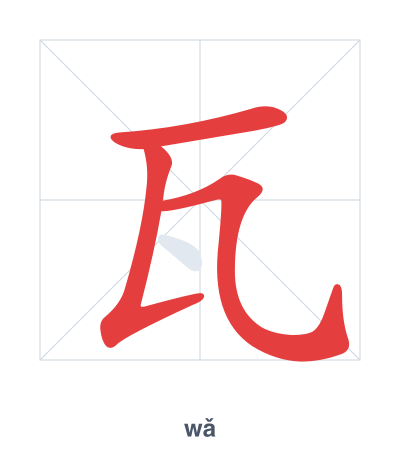
瓦 (wǎ) means "tile" in Chinese. It has 4 strokes with the radical 瓦. Difficulty: 2/5.
tile
The character 瓦 (wǎ) is written with 4 strokes. Follow the standard Chinese stroke order: top to bottom, left to right, outside before inside. The radical 瓦 is one of its key components.
Practice the correct stroke order with the Hanzi Writer app to see animated stroke-by-stroke guidance with real-time feedback.
瓦 is pronounced wǎ in Mandarin Chinese. It means tile.
This is a polyphonic character with readings: wǎ, wà.
暴风雨过后,房顶上的许多瓦片都被吹落了。
bào fēng yǔ guò hòu fáng dǐng shàng de xǔ duō wǎ piàn dōu bèi chuī là le
After the storm, many tiles on the roof were blown off.
经过我军的强大攻势,敌人的防线彻底瓦解了。
jīng guò wǒ jūn de qiáng dà gōng shì dí rén de fáng xiàn chè dǐ wǎ jiě le
Under the powerful offensive of our army, the enemy's defense line completely collapsed.
瓦工手里拿着一把锋利的瓦刀在砌墙。
wǎ gōng shǒu lǐ ná zhe yī bǎ fēng lì de wà dāo zài qì qiáng
The bricklayer is building a wall with a sharp trowel in his hand.
他住在瓦屋里。
tā zhù zài wǎ wū lǐ 。
He lives in a tiled house.
Open Hanzi Writer to see the animated stroke order and practice writing 瓦 with real-time feedback.